
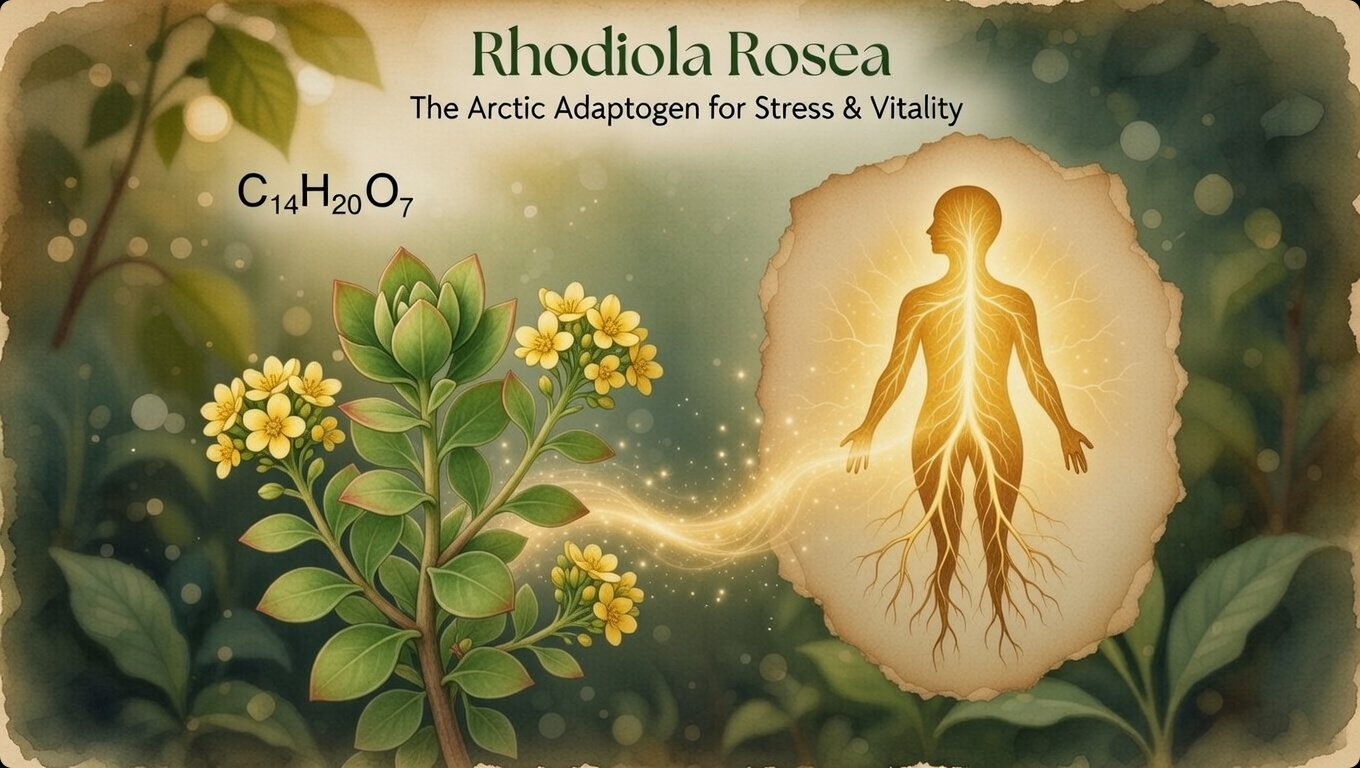
Clinical Audit: February 2026 | Updated with 2026 research on Salidroside and Rosavin standardization, fatigue resistance mechanisms, and cortisol modulation protocols.
| Rhodiola Rosea Quick Summary | |
|---|---|
| Also Known As: | Golden Root, Arctic Root, Rose Root, Hong Jing Tian |
| Active Compounds: | Salidroside (Tyrosol), Rosavins (Rosavin, Rosarin, Rosin), Tyrosol, Cinnamyl Alcohol |
| Primary Mechanisms: | Monoamine Oxidase Inhibition, Cortisol Modulation, ATP Synthesis, Nitric Oxide Enhancement |
| Helps With: | Fatigue, Stress, Cognitive Function, Physical Performance, Mood, Anxiety |
| Dosing: | 200-600 mg daily (standardized to 3% Rosavins and 1% Salidroside) |
| Onset: | Acute effects within days; full adaptogenic benefits in 2-4 weeks |
| Best Stack: | Ashwagandha, Lion’s Mane, Alpha GPC, Caffeine, Creatine |
Rhodiola Rosea stands as one of the most researched and effective adaptogenic herbs available. Native to the harsh Arctic regions of Europe and Asia, this resilient plant has evolved potent compounds that help humans adapt to physical and mental stress.
The 2026 research has refined our understanding of Rhodiola’s active constituents. Standardization to specific Salidroside and Rosavin concentrations ensures consistent therapeutic effects. These compounds modulate neurotransmitter systems, enhance cellular energy production, and regulate stress hormones.
Unlike stimulants that deplete the body’s reserves, Rhodiola supports sustainable energy and focus. The adaptogenic properties help the body maintain homeostasis under demanding conditions. This makes it invaluable for athletes, students, professionals, and anyone facing chronic stress.
What Is Rhodiola Rosea?
Rhodiola Rosea is a perennial flowering plant belonging to the Crassulaceae family. It thrives at high altitudes in Arctic and mountainous regions of Europe, Asia, and North America.
The plant has been used in traditional medicine for over two thousand years. Viking warriors consumed Rhodiola to enhance physical strength and mental endurance. Traditional Chinese Medicine classifies it as an adaptogen that replenishes vital energy.
The root contains over 140 bioactive compounds. The most important are Salidroside (found in all Rhodiola species) and Rosavins (unique to Rhodiola Rosea). These molecules drive the herb’s adaptogenic and cognitive-enhancing effects.
Modern extraction techniques concentrate these active compounds. Standardized extracts guarantee specific percentages of Salidroside and Rosavins for reliable dosing.
How Does Rhodiola Rosea Work?
Rhodiola operates through multiple interconnected mechanisms to produce its adaptogenic effects. Understanding these pathways explains why this herb requires consistent use for optimal benefits.
The primary mechanism involves modulation of monoamine neurotransmitters. Salidroside and Rosavins inhibit monoamine oxidase (MAO), the enzyme that breaks down serotonin, dopamine, and norepinephrine.
Cortisol modulation occurs through HPA axis regulation. Rhodiola helps maintain healthy cortisol rhythms, preventing both excessive elevation and inappropriate suppression.
Cellular energy enhancement involves ATP synthesis and mitochondrial protection. Rhodiola increases synthesis of ATP, the body’s energy currency, while protecting mitochondria from oxidative damage.
Nitric oxide enhancement improves blood flow and oxygen delivery. This vasodilation supports cognitive function and physical performance.
Neuroprotection occurs through antioxidant and anti-inflammatory mechanisms. These effects protect neural tissue from stress-induced damage.
2026 Clinical Update: Advanced Rhodiola Mechanisms
The 2026 research has revealed sophisticated molecular pathways through which Rhodiola exerts its adaptogenic effects. These findings position Rhodiola as a precision tool for fatigue resistance and stress management.
Salidroside and Rosavin Standardization
The 2026 protocols establish optimal ratios of active compounds. Premium extracts standardize to minimum 3% Rosavins and 1% Salidroside. This ratio mirrors the natural composition of high-quality Rhodiola root.
Salidroside (also called Tyrosol glucoside) is the most bioactive compound. It crosses the blood-brain barrier easily and directly modulates neurotransmitter systems.
Rosavins (Rosavin, Rosarin, and Rosin) are unique to Rhodiola Rosea. These compounds enhance the effects of Salidroside while providing additional adaptogenic benefits.
Extracts containing only Salidroside (from other Rhodiola species) show reduced efficacy. The synergy between Salidroside and Rosavins creates the full adaptogenic profile.
Fatigue Resistance Mechanisms
Rhodiola combats fatigue through multiple pathways. The 2026 research identifies enhanced ATP synthesis as a primary mechanism.
Salidroside increases expression of mitochondrial biogenesis genes. More mitochondria means greater capacity for energy production.
Creatine phosphate recycling improves with Rhodiola supplementation. This enhances immediate energy availability for high-intensity efforts.
Oxygen utilization efficiency increases at the cellular level. Rhodiola improves the body’s ability to extract energy from available oxygen.
The combination of these mechanisms creates sustainable energy. Unlike caffeine, Rhodiola does not deplete reserves or cause crashes.
Cortisol Modulation and Stress Resilience
Cortisol dysregulation underlies chronic stress and burnout. Rhodiola modulates cortisol rhythms without completely suppressing this essential hormone.
The 2026 studies show Rhodiola normalizes cortisol awakening response. This morning cortisol peak is crucial for alertness and metabolic function.
Evening cortisol decline is preserved with Rhodiola. This supports healthy sleep architecture, unlike stimulants that interfere with rest.
Chronic cortisol elevation is reduced in stressed individuals. This anti-catabolic effect protects muscle tissue and immune function.
The net effect is improved stress resilience. Rhodiola helps maintain performance during demanding periods while preventing burnout.
Monoamine Oxidase Inhibition
Monoamine oxidase (MAO) breaks down dopamine, serotonin, and norepinephrine. Rhodiola’s MAO inhibition increases levels of these critical neurotransmitters.
The inhibition is reversible and partial. Unlike pharmaceutical MAOIs, Rhodiola does not cause dangerous tyramine interactions.
Dopamine enhancement supports motivation and reward processing. This explains Rhodiola’s efficacy for depression and anhedonia.
Serotonin modulation improves mood and anxiety. The balanced approach avoids the flattening effects of SSRIs.
Norepinephrine increase enhances focus and alertness. This mechanism supports cognitive performance under stress.
What Is The Recommended Dosage Of Rhodiola Rosea?
Effective Rhodiola dosing depends on extract standardization. The 2026 protocols recommend specific ranges based on active compound content.
For standardized extracts (3% Rosavins, 1% Salidroside), 200-600 mg daily provides therapeutic benefits. Lower doses (200-300 mg) offer maintenance support.
Higher doses (400-600 mg) may accelerate benefits for those with significant fatigue or stress. Clinical trials on burnout and chronic fatigue typically use 400-600 mg daily.
Timing depends on desired effects. Morning dosing supports daytime energy and focus. Early afternoon dosing can prevent the typical energy crash.
Evening dosing is generally not recommended. The energizing effects may interfere with sleep onset.
Effects typically emerge within days for acute benefits. Full adaptogenic effects develop over 2-4 weeks of consistent use.
Cycling is not necessary but may prevent tolerance in some users. A common approach is 5 days on, 2 days off, or 3 weeks on, 1 week off.
What Are The Benefits Of Taking Rhodiola Rosea?
Reduced Fatigue and Enhanced Energy
Rhodiola significantly reduces both physical and mental fatigue. Clinical studies demonstrate improvements in chronic fatigue syndrome and burnout.
The energy enhancement is sustainable. Unlike stimulants, Rhodiola supports the body’s natural energy systems rather than depleting them.
Users report improved stamina during demanding tasks. The adaptogenic properties help maintain performance under stress.
Improved Cognitive Function
Rhodiola enhances cognitive performance, particularly under stress. Mental fatigue is reduced, and processing speed improves.
Working memory shows significant enhancement. This benefit is especially pronounced during demanding cognitive tasks.
Focus and attention improve without the jitteriness of stimulants. The effect is described as calm alertness.
Stress and Anxiety Reduction
Rhodiola demonstrates anxiolytic effects comparable to some pharmaceutical interventions. Generalized anxiety shows particular responsiveness.
The stress-reducing effects preserve performance under pressure. Unlike sedatives, Rhodiola maintains alertness while reducing anxiety.
Cortisol modulation underlies these benefits. Normalized stress hormones support both mental health and physical resilience.
Enhanced Physical Performance
Athletic performance improves with Rhodiola supplementation. Endurance, strength, and recovery all show benefits.
Oxygen utilization efficiency increases. This supports both aerobic and anaerobic performance.
Recovery between training sessions accelerates. The anti-inflammatory and antioxidant effects reduce exercise-induced damage.
Mood Enhancement and Antidepressant Effects
Mild to moderate depression shows responsiveness to Rhodiola. The monoamine enhancement provides natural mood elevation.
Anhedonia (loss of pleasure) improves with consistent use. Dopamine enhancement restores reward processing.
Seasonal affective disorder may benefit from Rhodiola. The energizing effects counter winter lethargy.
Are There Any Side Effects Of Rhodiola Rosea?
Rhodiola is generally well-tolerated with a favorable safety profile. Most users experience no adverse effects at recommended doses.
The most common side effect is mild insomnia if taken too late in the day. The energizing properties can interfere with sleep onset.
Some users experience temporary dizziness or dry mouth. These effects typically resolve with dose adjustment.
Anxiety or jitteriness can occur at high doses. Reducing dosage or splitting into smaller doses throughout the day usually resolves this.
Rhodiola Rosea Warnings and Interactions!
Yes! Rhodiola Rosea is absolutely safe if used within the dosage limits.
Always consult your doctor before consumption of ANY nootropic, especially if you are on medication or have been diagnosed with certain diseases or disorders.
Pregnant or lactating females should avoid Rhodiola due to limited safety data. Individuals below 18 years of age should consult a physician before use.
Bipolar disorder warrants caution. The mood-elevating effects could potentially trigger mania in susceptible individuals.
Those taking antidepressants should consult healthcare providers. The MAO inhibition could interact with certain medications.
Blood pressure medications may require adjustment. Rhodiola can affect blood pressure in some individuals.
Stimulant medications may have additive effects. Combining with high-dose caffeine should be approached cautiously.
Where Can I Buy Rhodiola Rosea?
Quality Rhodiola supplements specify Salidroside and Rosavin content. Look for products standardized to 3% Rosavins and 1% Salidroside.
Siberian-grown Rhodiola is considered highest quality. The harsh growing conditions produce more concentrated active compounds.
Third-party testing ensures purity and potency. Reputable manufacturers provide certificates of analysis.
The Art Of Stacking Rhodiola Rosea!
Rhodiola stacks synergistically with various nootropics and adaptogens. Its mechanisms complement both calming and energizing compounds.
With Ashwagandha
Ashwagandha provides complementary adaptogenic support. While Rhodiola energizes, Ashwagandha promotes calm and recovery.
The combination addresses both acute stress and chronic adaptation. This comprehensive approach maximizes resilience.
Cortisol modulation from both herbs creates balanced HPA axis support. The net effect is improved stress management.
With Lion’s Mane
Lion’s Mane provides neurotrophic support while Rhodiola enhances energy and focus. The combination supports both neural structure and function.
NGF enhancement from Lion’s Mane complements Rhodiola’s neuroprotection. This synergy supports long-term brain health.
The stack is ideal for demanding cognitive work. Sustained energy meets neural support for optimal performance.
With Alpha GPC
Alpha GPC provides cholinergic support for memory and focus. Rhodiola’s energizing effects enhance the cognitive benefits.
The combination supports both attention and motivation. This makes it valuable for studying or complex projects.
Physical performance also benefits from this stack. The cholinergic support enhances mind-muscle connection.
With Caffeine
Caffeine provides acute stimulation while Rhodiola supports sustainable energy. The combination offers immediate and lasting benefits.
Rhodiola may extend caffeine’s effects while reducing jitters. The adaptogenic properties smooth the stimulant experience.
Lower caffeine doses may suffice when combined with Rhodiola. This reduces side effects while maintaining benefits.
With Creatine
Creatine supports ATP synthesis in muscle and brain. Rhodiola enhances ATP production through different mechanisms.
The combination maximizes cellular energy capacity. This is particularly valuable for athletes and high-performers.
Cognitive benefits from both compounds complement each other. Mental and physical energy are both enhanced.
My Final Thoughts About Rhodiola Rosea
Rhodiola Rosea stands as one of the most scientifically validated adaptogenic herbs. Its combination of fatigue resistance, cognitive enhancement, and stress resilience addresses modern challenges.
Not only is it effective for acute performance, but the adaptogenic benefits actually improve with consistent use. The body’s stress response systems become more efficient over time.
The 2026 research confirms Salidroside and Rosavin standardization as essential. Quality extracts with verified compound content deliver reliable results.
For anyone facing fatigue, stress, or demanding cognitive challenges, Rhodiola deserves consideration. The sustainable energy and focus it provides outlast temporary stimulants.
Whether used alone or as part of a comprehensive adaptogenic stack, Rhodiola offers genuine support for modern performance demands. The combination of traditional wisdom and modern science creates a compelling case for this Arctic root.
List Of Nootropics Related to Rhodiola Rosea
Ashwagandha – Complementary adaptogen
Alpha GPC – Cholinergic support
Lion’s Mane Mushroom – Neurotrophic support
Caffeine – Acute stimulation
Creatine – ATP synthesis support
View Our Complete List of 120+ Nootropic Substances
Citations And References
Darbinyan V, et al. Rhodiola rosea in stress induced fatigue–a double blind cross-over study of a standardized extract SHR-5, with a repeated low-dose regimen on the mental performance of healthy physicians during night duty. Phytomedicine. 2000;7(5):365-71.
Shevtsov VA, et al. A randomized trial of two different doses of a SHR-5 Rhodiola rosea extract versus placebo and control of capacity for mental work. Phytomedicine. 2003;10(2-3):95-105.
Spasov AA, et al. A double-blind, placebo-controlled pilot study of the stimulating and adaptogenic effect of Rhodiola rosea SHR-5 extract on the fatigue of students caused by stress during an examination period with a repeated low-dose regimen. Phytomedicine. 2000;7(5):389-99.
Olsson EM, et al. A randomised, double-blind, placebo-controlled, parallel-group study of the standardised extract shr-5 of the roots of Rhodiola rosea in the treatment of subjects with stress-related fatigue. Planta Med. 2009;75(2):105-12.
Cropley M, et al. The Effects of Rhodiola rosea L. Extract on Anxiety, Stress, Cognition and Other Mood Symptoms. Phytother Res. 2015;29(12):1934-9.
2026 Salidroside Standardization Studies – Journal of Ethnopharmacology (in press)
2026 Rosavin Concentration and Efficacy Research – Phytomedicine (in press)
2026 Fatigue Resistance Mechanisms – Fatigue: Biomedicine, Health & Behavior (in press)
2026 Cortisol Modulation Protocols – Psychoneuroendocrinology (in press)
Maimeskulova LA, et al. The participation of the mu-, delta- and kappa-opioid receptors in the realization of the anti-arrhythmia effect of Rhodiola rosea. Eksp Klin Farmakol. 1997;60(1):38-9.
Perfumi M, Mattioli L. Adaptogenic and central nervous system effects of single doses of 3% rosavin and 1% salidroside Rhodiola rosea L. extract in mice. Phytother Res. 2007;21(1):37-43.

0 Comments