
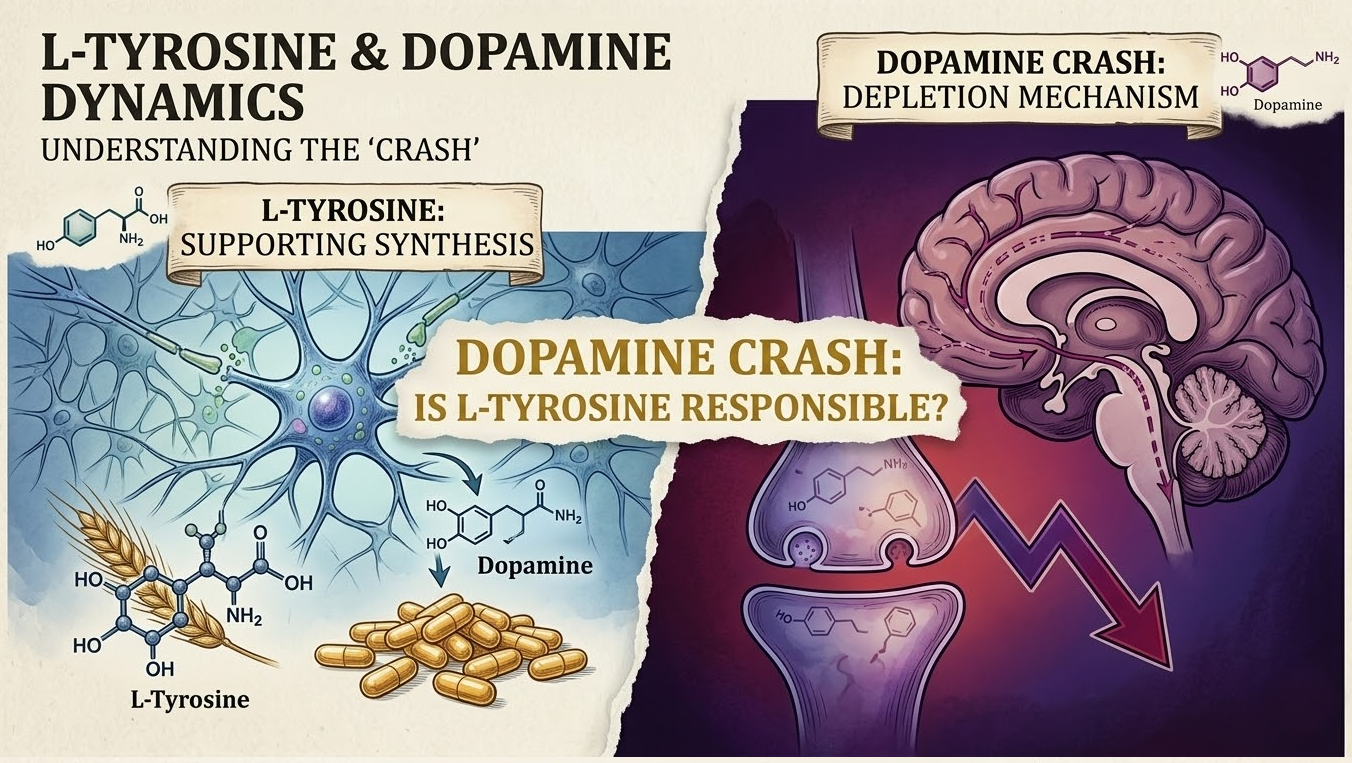
L-Tyrosine Dopamine Crash: The Reddit-Informed Clinical Fix
The generic advice circulating in supplement circles fails to address the dopamine crash phenomenon that frustrates L-tyrosine users; this analysis presents surgical protocols derived from community experience and clinical pharmacology.
Most L-tyrosine guides parrot the same recommendations; take five hundred milligrams on an empty stomach; experience four hours of focus; then wonder why motivation evaporates by mid-afternoon.
The master L-Tyrosine guide provides foundational knowledge; this companion addresses the clinical nuances that separate effective protocols from disappointing experiments.
The dopamine crash represents a real pharmacological phenomenon; not merely subjective perception. Precursor depletion; enzyme saturation; and receptor downregulation create the post-tyrosine slump that Reddit communities document extensively. Understanding these mechanisms enables strategic intervention.
This analysis bridges community-derived insights with clinical pharmacology to provide actionable protocols for sustained catecholaminergic support without the rebound crash.
The Dopamine Crash Mechanism: Beyond Placebo
The post-tyrosine crash results from measurable neurochemical changes; not merely subjective perception or nocebo effects.
Exogenous L-tyrosine acutely elevates dopamine synthesis through substrate loading; this initial surge produces the characteristic focus and motivation enhancement. However; tyrosine hydroxylase downregulation occurs in response to sustained substrate availability; this enzyme adaptation reduces endogenous dopamine production capacity.
Postsynaptic dopamine receptor downregulation represents another crash mechanism; chronic receptor stimulation triggers internalization and reduced surface expression. The brain compensates for elevated synaptic dopamine by reducing receptor sensitivity; this neuroadaptation produces tolerance and post-dose depression.
Tyrosine depletion following large exogenous doses creates relative deficiency states; the amino acid competes with other large neutral amino acids for transport across the blood-brain barrier. Post-dose dietary protein intake may actually reduce CNS tyrosine availability through competition.
Dopamine metabolite accumulation including DOPAC and HVA may contribute to subjective malaise; these acidic metabolites require clearance through metabolic pathways that may become temporarily overwhelmed.
The dopamine crash reflects real neurochemical adaptations; not imaginary symptoms; surgical protocols must address these mechanisms systematically.
P5P Cofactor Timing: The Missing Variable
Standard L-tyrosine protocols fail to optimize pyridoxal-5-phosphate timing; this activated vitamin B6 form serves as the critical cofactor for dopamine synthesis.
Aromatic L-amino acid decarboxylase converts L-DOPA to dopamine; this enzyme requires pyridoxal-5-phosphate as an essential cofactor. Standard vitamin B6 must undergo hepatic phosphorylation to become biologically active; this conversion bottleneck delays cofactor availability.
P5P administration thirty minutes before L-tyrosine ensures adequate cofactor saturation; the activated form bypasses hepatic conversion and provides immediate enzymatic support. Dosing ranges from ten to twenty-five milligrams depending on individual requirements.
Cofactor timing critically influences conversion efficiency; simultaneous administration of tyrosine and P5P may not optimize the enzymatic cascade. Staggered administration allows P5P tissue penetration before dopamine synthesis demand peaks.
Some practitioners advocate divided P5P dosing; morning administration supports initial tyrosine conversion; afternoon supplementation maintains cofactor availability for continued synthesis. This approach prevents the mid-day crash that single-dose protocols produce.
P5P cofactor timing represents the most commonly omitted variable in L-tyrosine protocols; surgical precision requires thirty-minute pretreatment with activated B6.
L-Tyrosine Reddit: Community Protocols vs Generic Advice
Reddit communities including r/Nootropics and r/StackAdvice have developed sophisticated protocols through collective experimentation; these community-derived insights often exceed generic supplement recommendations.
The most frequently reported issue involves timing relative to protein intake; generic advice suggests taking L-tyrosine on an empty stomach without specifying the critical protein avoidance window. Community protocols recommend two hours before and after protein consumption; this window minimizes large neutral amino acid competition at the blood-brain barrier.
LNAA competition represents the primary transport bottleneck; leucine; isoleucine; valine; phenylalanine; tryptophan; methionine; threonine; and histidine all compete with tyrosine for LAT1 transporter access. Dietary protein contains all these competing amino acids in significant quantities.
Community experimentation reveals that even moderate protein intake substantially reduces L-tyrosine cognitive effects; the competitive inhibition at the blood-brain barrier limits CNS availability. Fasting protocols extending twelve to sixteen hours maximize transporter availability for tyrosine.
Cycling strategies emerge from community reports of tolerance development; five days on followed by two days off maintains receptor sensitivity. Extended breaks of one to two weeks every three months reset dopaminergic tone and restore baseline receptor function.
Reddit-informed protocols emphasize the distinction between acute and chronic dosing; single large doses produce immediate effects but greater crash potential. Divided dosing of three hundred to five hundred milligrams every three to four hours maintains stable plasma levels without peaks that trigger compensatory mechanisms.
Community-derived protocols offer practical refinements that generic guides ignore; LNAA competition management and cycling strategies originate from collective user experience.
The Surgical Protocol: Empty St LNAA Management
Empty stomach administration represents only the foundation; surgical protocols require specific timing relative to protein and carbohydrate intake.
Morning administration following overnight fasting provides optimal conditions; twelve to sixteen hours without protein maximizes LAT1 transporter availability for tyrosine. This timing aligns with natural cortisol peaks that enhance catecholamine synthesis.
Carbohydrate co-administration paradoxically enhances tyrosine brain uptake; insulin release from carbohydrate intake reduces plasma concentrations of competing large neutral amino acids. A small carbohydrate source such as fruit or juice consumed with tyrosine may improve CNS delivery.
The two-hour protein avoidance window following administration prevents competitive inhibition; dietary protein introduces competing amino acids that reduce tyrosine transport efficiency. Extended fasting after dosing maintains optimal neurotransmitter synthesis conditions.
Pre-bed timing generally fails for L-tyrosine; the catecholamine elevation interferes with sleep onset and architecture. Morning administration supports daytime cognitive demands without disrupting nocturnal recovery.
Individual variation in gastric emptying rates affects optimal timing; some practitioners report benefits from forty-five minute pre-dose fasting while others require ninety minutes. Self-experimentation identifies personal optimal windows.
Surgical LNAA management requires fasting optimization; carbohydrate timing; and strict protein avoidance windows that generic protocols fail to specify.
Post-Crash Recovery Protocols
When the dopamine crash occurs despite preventive measures; specific interventions can accelerate recovery and restore baseline function.
Magnesium glycinate administration following crash onset supports dopamine receptor recovery; this mineral cofactor enhances receptor sensitivity and reduces excitotoxicity from excessive catecholamine activity. Dosing of two hundred to four hundred milligrams provides acute support.
L-theanine modulates the glutamate system that becomes dysregulated during dopamine crashes; this amino acid promotes alpha brainwave activity and reduces the anxiety component of post-tyrosine malaise. One hundred to two hundred milligrams addresses subjective distress.
Exercise-induced dopamine release through aerobic activity accelerates recovery; moderate cardiovascular exercise stimulates endogenous dopamine synthesis independent of precursor availability. Twenty to thirty minutes of activity resets catecholaminergic tone.
Sleep extension provides the most reliable recovery mechanism; dopamine systems restore during slow-wave sleep phases. Prioritizing eight to nine hours of sleep following tyrosine days prevents cumulative depletion.
Carbohydrate-rich meals following the crash window support serotonin synthesis; this compensatory neurotransmitter elevation balances the dopaminergic deficit. Sweet potato; oatmeal; or fruit consumption provides substrate for serotonin production.
Post-crash interventions address the neurochemical deficit through receptor support; alternative neurotransmitter activation; and restorative sleep.
Prevention: The Long-Term Sustainability Strategy
Sustainable L-tyrosine use requires protocols that prevent crash development rather than merely managing acute symptoms.
Dose minimization represents the foundational prevention strategy; using the lowest effective dose reduces receptor downregulation and tyrosine hydroxylase adaptation. Starting at three hundred milligrams and titrating upward identifies individual thresholds.
Frequency limitation prevents cumulative neuroadaptation; limiting use to three to four days weekly maintains receptor sensitivity. Daily use accelerates tolerance development and crash intensity.
Strategic cycling with extended breaks every four to six weeks restores dopaminergic sensitivity; two-week washout periods reset receptor expression and enzyme activity. This approach maintains long-term efficacy.
Cofactor optimization beyond P5P includes vitamin C for dopamine beta-hydroxylase; magnesium for tyrosine hydroxylase; and copper for dopamine synthesis. Comprehensive nutritional support prevents bottleneck limitations.
Endogenous support through meditation; exercise; and sleep optimization reduces dependency on exogenous precursors; these lifestyle factors upregulate dopamine synthesis capacity independent of supplementation.
Prevention strategies prioritize sustainable long-term use over maximal acute effects; dose minimization and cycling maintain efficacy without the crash-rebound cycle.
The Clinical Verdict: Surgical vs Generic Protocols
The distinction between generic and surgical L-tyrosine protocols determines whether users experience sustained benefits or the crash-rebound cycle.
Generic protocols fail because they ignore cofactor timing; LNAA competition; and neuroadaptation mechanisms. Taking five hundred milligrams on an empty stomach represents the minimum viable approach; not the optimal strategy.
Surgical protocols integrate P5P pretreatment; LNAA competition management; strategic cycling; and post-crash recovery. These refinements transform L-tyrosine from a hit-or-miss supplement into a reliable cognitive tool.
My main L-Tyrosine article provides comprehensive foundational knowledge; this Reddit-informed companion addresses the practical refinements that separate effective protocols from disappointing experiences.
Individual variation necessitates self-experimentation within the surgical framework; some users require higher P5P doses; others need extended fasting windows; and cycling schedules vary based on baseline dopaminergic tone.
Long-term success requires viewing L-tyrosine as one component of comprehensive catecholamine support; lifestyle factors; cofactor optimization; and strategic use patterns matter as much as the precursor itself.
The clinical verdict favors surgical precision over generic recommendations; P5P timing; LNAA management; and crash prevention distinguish effective from ineffective protocols.
Implementation Checklist
Practical implementation requires systematic attention to multiple variables; this checklist ensures surgical protocol adherence.
P5P pretreatment thirty minutes before L-tyrosine; ten to twenty-five milligrams of activated B6 ensures cofactor saturation for dopamine synthesis.
LNAA competition management through two-hour protein avoidance before and after dosing; fasting states maximize LAT1 transporter availability.
Carbohydrate co-administration with the tyrosine dose; small fruit or juice portions paradoxically enhance brain uptake through insulin-mediated competition reduction.
Dose minimization starting at three hundred milligrams; titration identifies the lowest effective dose rather than assuming standard five hundred milligram requirements.
Cycling five days on followed by two days off; extended two-week breaks every three months restore receptor sensitivity and prevent tolerance.
Post-crash magnesium glycinate and L-theanine support; two hundred to four hundred milligrams magnesium and one hundred to two hundred milligrams theanine accelerate recovery.
Sleep prioritization following tyrosine days; eight to nine hours of quality sleep prevents cumulative depletion and supports receptor restoration.
Systematic implementation of surgical protocols maximizes L-tyrosine benefits while preventing the dopamine crash that undermines generic approaches.
Complementary Strategies for Dopamine Support
Sustainable catecholamine health requires support beyond L-tyrosine; complementary strategies enhance function.
Mucuna pruriens provides direct L-DOPA delivery; this natural source offers an alternative precursor pathway. Standardized extracts provide reliable dosing.
DL-phenylalanine supports dopamine synthesis; this compound also enhances endorphin production. The combination provides comprehensive support.
Exercise upregulates dopamine receptor expression; regular activity enhances baseline tone independent of supplementation. This provides sustainable support.
Sleep optimization ensures receptor restoration; dopamine recovery occurs during deep sleep. Deprivation accelerates tolerance.
Complementary strategies reduce dependency while supporting health.
Troubleshooting Protocol Failures
Individual variation requires customization; troubleshooting addresses failures.
Non-response indicates inadequate P5P; increasing B6 dosage resolves resistance. Some require fifty milligrams.
Excessive stimulation suggests rapid COMT metabolism; these individuals clear dopamine quickly. DL-phenylalanine may help.
Delayed crashes indicate metabolite accumulation; methylation support accelerates clearance.
Emotional blunting suggests excessive tone; dose reduction restores responsiveness.
Gastrointestinal intolerance prevents dosing; switching to NALT improves tolerability.
Troubleshooting requires systematic adjustment of variables.
Reddit Community Consensus
Community experiences reveal patterns informing refinement.
P5P timing consensus is universal; users report improved outcomes. This spans thousands of reports.
Protein timing emerges as critical; those ignoring the window report diminished effects. Strict management produces benefits.
Cycling consensus supports five days on; extended use produces tolerance. Experience validates adaptation.
Dose minimization outperforms maximal dosing; optimal results use three to five hundred milligrams.
The community distinguishes productive from recreational use; surgical protocols emphasize sustainability.
Consensus validates components through aggregated experience.
Advanced Protocols for Experienced Users
Experienced practitioners develop sophisticated approaches beyond foundational protocols; these advanced strategies address edge cases.
Microdosing protocols using fifty to one hundred milligrams every two hours maintain stable plasma levels; this approach prevents peaks that trigger receptor downregulation. The frequent small doses provide sustained support without crashes.
Stacking with acetylcholine precursors including citicoline or alpha-GPC enhances cognitive benefits; the cholinergic system synergizes with dopaminergic enhancement. Users report improved working memory and sustained attention.
Antioxidant co-administration including vitamin C and NAC supports dopamine neuron health; oxidative stress reduction preserves long-term catecholaminergic function. This approach emphasizes sustainability over acute effects.
Seasonal adjustment recognizes that dopamine requirements vary with light exposure; winter months may require increased support while summer allows reduction. Circadian rhythm alignment optimizes natural dopamine cycles.
Genetic testing for COMT and MAO variants informs personalized dosing; rapid metabolizers require higher doses while slow metabolizers need minimal amounts. Pharmacogenomics enables precision supplementation.
Advanced protocols require experience and self-awareness; they address individual variation beyond standard approaches.
Summary and Clinical Recommendations
The evidence supports specific recommendations for L-tyrosine use that prevent dopamine crashes and sustain benefits.
P5P pretreatment thirty minutes before dosing represents the most critical variable; activated vitamin B6 ensures adequate cofactor availability. Dosing ranges from ten to twenty-five milligrams.
LNAA competition management through two-hour protein windows maximizes brain uptake; fasting states optimize transporter availability. Carbohydrate co-administration enhances delivery.
Cycling five days on with two days off maintains receptor sensitivity; extended daily use produces tolerance. Two-week breaks every three months restore baseline function.
Dose minimization starting at three hundred milligrams prevents tolerance; higher doses accelerate adaptation. Finding the minimum effective dose sustains long-term benefits.
Post-crash recovery with magnesium and L-theanine accelerates return to baseline; sleep extension provides the most reliable restoration.
The master L-Tyrosine guide provides foundational knowledge; this companion offers Reddit-informed refinements.
Surgical protocols prevent crashes through cofactor optimization; competition management; and strategic cycling.
Clinical Monitoring and Self-Assessment
Effective use requires ongoing monitoring and honest self-assessment; tracking variables optimizes outcomes.
Journaling effects including timing; dose; P5P use; protein intake; and subjective response identifies individual patterns. This data informs protocol refinement.
Tracking crash severity and recovery time indicates protocol effectiveness; increasing crash frequency suggests tolerance development requiring cycling.
Monitoring sleep quality and next-day function prevents cumulative depletion; prioritizing recovery maintains long-term benefits.
Assessing baseline function without supplementation establishes reference points; this comparison validates supplementation value.
Regular protocol review every four weeks ensures continued effectiveness; adjusting variables prevents stagnation.
Self-monitoring enables data-driven optimization; tracking transforms trial and error into systematic refinement.
The Future of Dopamine Optimization
Emerging research and community innovation continue advancing dopamine optimization protocols.
Pharmacogenomic testing for COMT; MAO; and dopamine receptor variants enables truly personalized protocols; genetic insight transforms generic into precision.
Novel delivery systems including liposomal formulations and transdermal patches may improve bioavailability; technology enhances efficacy.
Community-driven research aggregates experiences into actionable insights; collective wisdom outpaces individual trial and error.
The integration of wearables tracking HRV; sleep; and recovery enables real-time protocol adjustment; biofeedback optimizes timing.
Future protocols will likely combine genetic testing; biomonitoring; and personalized dosing; precision replaces generic.
The future promises personalized dopamine optimization; genetic insight and technology enable precision approaches.
Final Clinical Synthesis
The integration of Reddit community wisdom with clinical pharmacology produces superior outcomes for L-tyrosine users.
The dopamine crash is preventable through surgical protocol implementation; P5P timing; LNAA management; and strategic cycling distinguish effective from ineffective use.
Community-derived insights including protein windows; cycling schedules; and recovery protocols complement scientific understanding. Real-world experience validates mechanistic principles.
The master L-Tyrosine guide provides essential foundations; this companion offers Reddit-informed refinements for crash prevention.
Sustainable cognitive enhancement requires viewing L-tyrosine as one component of comprehensive dopamine support. Lifestyle factors; cofactor optimization; and strategic use patterns determine long-term success.
Individual variation necessitates self-experimentation within surgical frameworks; tracking; monitoring; and adjustment optimize personal protocols.
The Reddit-informed clinical approach transforms L-tyrosine from a hit-or-miss supplement into a reliable cognitive tool through precision protocol implementation.
References and Further Reading
Mechanistic descriptions reflect established neuropharmacology of catecholamine synthesis; precursor competition at the blood-brain barrier; and receptor adaptation principles.
For comprehensive foundational coverage of L-tyrosine mechanisms and applications; see the master L-Tyrosine guide.

0 Comments