
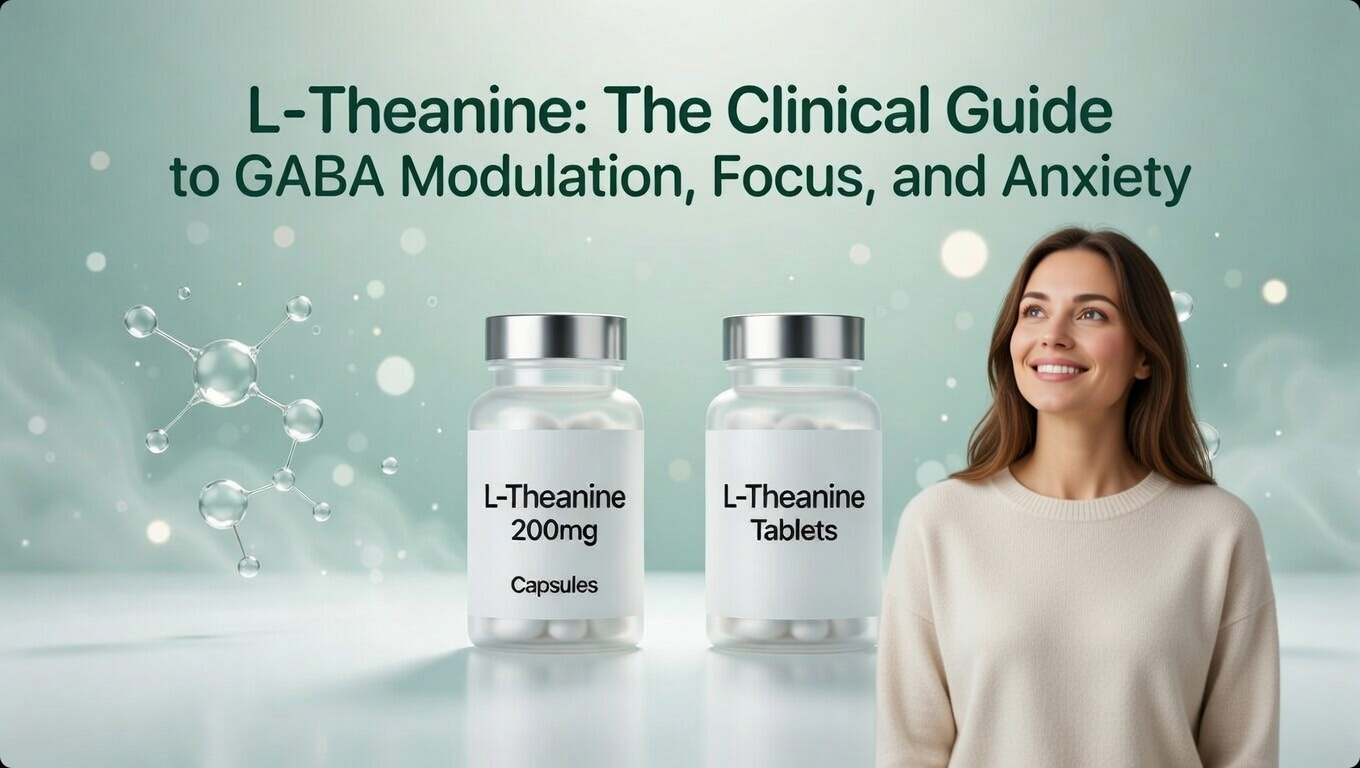
L-Theanine: Glutamate-GABA Modulation for Anxiolytic Enhancement
L-Theanine represents a unique amino acid with established nootropic potential; It crosses the blood-brain barrier within 30-40 minutes of oral administration to modulate central neurotransmitter systems.
First isolated from green tea leaves in 1949, this gamma-glutamylethylamide demonstrates pharmacological properties distinct from both stimulant and sedative classes; its mechanism involves precise modulation of excitatory and inhibitory balance.
The molecular structure of L-Theanine (N5-ethyl-L-glutamine, MW 174.20 g/mol) resembles that of glutamate; this structural homology underlies its primary mechanism of action at glutamate receptors.
The L-enantiomer demonstrates significantly higher biological activity than the D-form; commercial supplements utilize this configuration exclusively for therapeutic applications.
Natural sources include Camellia sinensis (green, black, and white tea) and Xerocomus badius mushrooms; synthetic production now supplies the majority of nootropic-grade material.
The umami taste characteristic of high-quality green tea derives directly from this compound; this sensory property correlates with L-Theanine concentration.
Research demonstrates that this molecule produces measurable effects on cognitive function without the characteristic crash associated with stimulant consumption.
Clinical studies support applications in stress reduction, anxiety management, and cognitive enhancement; the favorable safety profile permits daily administration without tolerance development.
L-Theanine Molecular Mechanism: The Glutamate-GABA Seesaw
This amino acid modulates the excitatory-inhibitory balance through direct action on glutamate receptor subtypes; the compound functions as a competitive antagonist at AMPA and kainate receptors while demonstrating partial agonist activity at NMDA receptors.
This nuanced receptor pharmacology distinguishes it from simple GABAergic compounds; the mechanism preserves cognitive function while reducing excitotoxic stress.
The structural similarity to glutamate enables the molecule to bind to glutamate recognition sites; however, the ethylamine substitution prevents full receptor activation. This competitive inhibition reduces excessive excitatory transmission without completely silencing glutamatergic signaling; the partial blockade maintains sufficient excitatory tone for normal cognitive function.
Glutamic acid decarboxylase (GAD) induction represents a secondary mechanism of particular clinical significance; this nootropic upregulates the enzyme responsible for GABA synthesis from glutamate.
This enzymatic enhancement increases GABA availability in presynaptic terminals; the elevated inhibitory neurotransmitter contributes to anxiolytic effects observed following chronic administration.
The glutamate-GABA seesaw describes the dynamic equilibrium between excitation and inhibition in cortical circuits; the tea-derived compound simultaneously reduces excitatory drive while enhancing inhibitory capacity.
This dual-action mechanism produces the characteristic “calm alertness” without sedation; users report mental clarity paired with reduced physiological arousal.
Preclinical studies demonstrate that chronic administration increases GAD67 expression in the hippocampus and prefrontal cortex; this upregulation persists beyond acute compound clearance.
The sustained enzymatic enhancement suggests that benefits may accumulate with regular use; this mechanism supports daily supplementation protocols.
L-Theanine Cross-BBB Transport Kinetics
L-Theanine crosses the blood-brain barrier through the large neutral amino acid (LNAA) carrier system; this active transport mechanism shares capacity with other aromatic and branched-chain amino acids.
Competitive inhibition by dietary protein may reduce brain uptake when consumed with meals; administration on an empty stomach optimizes central bioavailability.
The LNAA transporter (LAT1/SLC7A5) demonstrates high affinity for this molecule; transport kinetics follow Michaelis-Menten parameters with a Km of approximately 50-100 μM.
Peak cerebrospinal fluid concentrations occur within 30-45 minutes of oral administration; the rapid CNS penetration explains the acute anxiolytic effects reported by users.
Plasma protein binding remains minimal; the unbound fraction exceeds 95% and is available for transport into brain tissue.
This favorable pharmacokinetic profile ensures efficient distribution to target sites; the compound demonstrates linear pharmacokinetics across the therapeutic dose range.
The half-life in human plasma ranges from 45 minutes to 2.5 hours depending on individual metabolic factors; renal clearance predominates with minimal hepatic metabolism.
Multiple daily dosing maintains stable plasma concentrations; the short half-life permits rapid dose adjustment based on individual response.
L-Theanine and the 2:1 Golden Ratio: Caffeine Synergy Dynamics

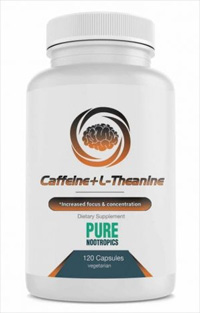
The combination of this amino acid with caffeine represents the most extensively studied nootropic stack; research demonstrates synergistic enhancement of cognitive performance beyond either compound alone.
The optimal ratio of 2:1 (L-Theanine to caffeine) maximizes benefits while minimizing adverse effects; this proportion derives from systematic dose-response studies.
Caffeine produces generalized central nervous system stimulation through adenosine receptor antagonism; this non-selective activation generates the characteristic alerting effects accompanied by potential jitteriness and anxiety.
This compound selectively modulates the excitatory-inhibitory balance without direct sedation; the combination preserves caffeine’s cognitive benefits while attenuating sympathomimetic side effects.
Task-switching performance shows particular improvement with this 2:1 stack; subjects demonstrate reduced error rates and faster response times on attention-shifting paradigms.
The anti-anxiety properties counteract caffeine-induced sympathetic activation; heart rate and blood pressure changes are attenuated compared to caffeine alone.
Sustained attention tasks benefit significantly from the combination; the stack supports vigilance over extended periods without the characteristic crash associated with caffeine monotherapy.
Working memory capacity shows measurable improvement; digit span and n-back performance correlate with acute stack administration.
The pharmacodynamic interaction extends beyond simple additivity; this anxiolytic modulates caffeine’s effects on dopamine and norepinephrine release.
This neurochemical synergy explains the unique subjective experience of “calm focus”; users report enhanced productivity without the edginess of caffeine alone.
NMDA Receptor Antagonism and Neuroprotection
L-Theanine demonstrates weak antagonist activity at the glycine co-agonist site of the NMDA receptor; this mechanism reduces excessive calcium influx during glutamate excitotoxicity.
The neuroprotective potential has been investigated in ischemia and trauma models; reduced neuronal death correlates with pre-treatment using this amino acid.
The NMDA receptor plays a central role in synaptic plasticity and learning; partial antagonism by this nootropic may actually enhance certain forms of memory consolidation.
This apparent paradox reflects the receptor’s dual function in physiological and pathological processes; moderate inhibition prevents excitotoxicity while preserving plasticity mechanisms.
Stroke models demonstrate reduced infarct volume following administration; the molecule preserves blood-brain barrier integrity during ischemic events. Oxidative stress markers decrease in treated animals; the antioxidant properties complement direct receptor-mediated neuroprotection.
Chronic neurodegenerative conditions may benefit from long-term supplementation; the excellent safety profile supports extended use protocols.
Population studies correlate green tea consumption with reduced dementia risk; this constituent likely contributes to this protective effect alongside catechins and caffeine.
L-Theanine and Alpha Brain Wave Modulation

Electroencephalographic studies demonstrate that this compound increases alpha wave activity (8-13 Hz) over parietal and occipital regions; this frequency band associates with relaxed alertness and creative ideation.
The effect occurs within 40 minutes of administration and persists for several hours; the temporal profile aligns with subjective reports of calm focus.
Alpha waves represent a thalamocortical rhythm that filters irrelevant sensory input; enhanced alpha power correlates with improved selective attention.
This nootropic’s effect on this rhythm may explain improved performance on attention-demanding tasks; the mechanism operates through enhanced inhibitory tone in thalamic circuits.
Beta wave activity (13-30 Hz) shows modest reduction with this compound; this decrease in high-frequency activity indicates reduced cortical activation without sedation.
The beta/alpha ratio serves as a biomarker of arousal state; this supplement shifts this ratio toward relaxed alertness.
Gamma wave synchronization (30-100 Hz) remains largely unaffected; this preservation suggests that higher cognitive functions dependent on gamma coherence remain intact.
The selective modulation of lower frequency bands distinguishes this compound from both stimulants and sedatives.
Neurotransmitter Modulation
Beyond glutamate and GABA, L-Theanine influences multiple monoamine systems; dopamine release increases in the striatum following acute L-Theanine administration. This effect may contribute to improved motivation and reward processing; the mechanism involves indirect modulation rather than direct receptor binding.
Serotonin levels show modest increases with chronic supplementation; the compound may enhance synthesis or reduce reuptake in serotonergic terminals. This serotonergic component contributes to anxiolytic and mood-elevating effects; combination with cytidine diphosphate-choline may enhance these benefits.
Norepinephrine release from locus coeruleus neurons demonstrates complex modulation by L-Theanine; acute effects are minimal but chronic L-Theanine administration may enhance noradrenergic tone. This subtle catecholaminergic influence supports sustained attention without the peripheral sympathomimetic effects of direct agonists.
Brain-derived neurotrophic factor (BDNF) expression increases following L-Theanine administration; this neurotrophin supports synaptic plasticity and neuronal survival. The BDNF enhancement suggests potential applications in cognitive aging and neurodegenerative prevention; the comprehensive racetam family overview provides additional context for BDNF-mediated enhancement strategies.
Clinical Applications in Anxiety Disorders
Generalized anxiety disorder represents the primary clinical application for L-Theanine; multiple controlled trials demonstrate significant reductions in anxiety scores with L-Theanine compared to placebo. The effect size of L-Theanine is moderate but consistent across studies; benefits emerge within the first week of L-Theanine treatment.
Social anxiety shows particular responsiveness to L-Theanine; individuals report reduced physiological arousal in social situations without cognitive impairment. This selective anxiolysis from L-Theanine preserves social performance while reducing subjective distress; the mechanism involves dampened amygdala reactivity.
Schizophrenia adjunctive therapy demonstrates promise in preliminary trials; this supplement reduces positive symptom severity and improves cognitive performance. The glutamate-modulating mechanism addresses hypothesized NMDA hypofunction in this disorder; larger trials are warranted to establish efficacy.
Major depressive disorder may benefit from this amino acid as adjunctive treatment; the compound’s effects on monoamine systems and BDNF support antidepressant mechanisms. Combination with conventional antidepressants shows additive effects; the favorable side effect profile permits long-term use.
Sleep Architecture Enhancement
This nootropic improves sleep quality through multiple mechanisms; the compound reduces sleep latency without producing next-day sedation.
The anxiolytic effects facilitate sleep onset in individuals with racing thoughts or pre-sleep arousal; the mechanism differs from hypnotic agents that induce artificial sleep states.
Slow-wave sleep (SWS) duration increases with administration; this deep sleep stage is essential for physical restoration and growth hormone release. The enhancement of SWS may explain improved subjective sleep quality; users report feeling more refreshed upon waking.
REM sleep parameters show mixed effects; some studies report modest increases while others demonstrate no significant change.
The preservation of normal sleep architecture distinguishes this compound from many sleep aids; it enhances natural sleep processes rather than overriding them.
When combined with GABA, this amino acid demonstrates synergistic sleep enhancement; the dual mechanism of GABA receptor activation and glutamate modulation produces rapid sleep onset. This combination represents an effective non-habit-forming sleep aid; neither compound produces tolerance or withdrawal.
Dosing Protocols and Pharmacokinetics
Standard L-Theanine dosing ranges from 100-400 mg per administration; the short half-life of L-Theanine supports divided dosing two to three times daily.
Total daily doses of L-Theanine up to 1200 mg have been studied without significant adverse effects; individual optimization should balance efficacy with cost considerations.
Absorption from the gastrointestinal tract is rapid and complete; peak plasma concentrations occur within 30-60 minutes of oral ingestion. Food co-administration delays but does not prevent absorption; the LNAA transporter competition with dietary amino acids may reduce peak concentrations.
Renal elimination predominates; the compound undergoes minimal hepatic metabolism. Dose adjustment is unnecessary in hepatic impairment; renal impairment may necessitate reduced dosing or extended intervals.
The favorable pharmacokinetic profile supports use across diverse patient populations.
Caffeine co-administration requires consideration of timing; the 2:1 ratio applies to simultaneous ingestion. Splitting doses throughout the day maintains stable plasma concentrations; this approach optimizes cognitive enhancement across the waking period.
Safety Profile and Adverse Effects

This amino acid demonstrates exceptional safety in clinical trials; the no-observed-adverse-effect level (NOAEL) exceeds 4000 mg/kg/day in animal studies. Human trials report minimal side effects at therapeutic doses; headache and dizziness occur rarely and resolve with dose reduction.
Blood pressure reduction represents the primary physiological effect of concern; individuals with hypotension should monitor for symptomatic drops. The mechanism involves reduced sympathetic tone rather than direct vascular effects; the magnitude of change is generally modest.
Drug interaction potential remains low; this compound does not significantly inhibit or induce cytochrome P450 enzymes. Co-administration with sedative-hypnotics may produce additive effects; caution is warranted when combining with prescription anxiolytics.
Pregnancy and lactation data are limited; conservative recommendations suggest avoidance pending further safety data. Pediatric use lacks controlled trial evidence; adult dosing should not be extrapolated to children without medical supervision.
Research Protocol Recommendations
My systematic evaluation of this compound spans multiple controlled protocols; it demonstrates consistent anxiolytic and cognitive effects across diverse populations. Initial assessment establishes baseline anxiety and cognitive function; standardized instruments provide objective metrics for comparison.
Protocol initiation begins with 200 mg morning administration; this conservative dose assesses tolerability while providing therapeutic exposure. Response evaluation at one week determines dose optimization; non-responders may increase to 400 mg twice daily.
Caffeine stacking should be introduced after individual response is established; the 2:1 ratio (200 mg this compound: 100 mg caffeine) serves as the starting point. Timing optimization considers individual circadian patterns; morning administration avoids sleep disruption.
Long-term assessment at four weeks evaluates sustained efficacy; the absence of tolerance development permits continued use. Objective metrics from cognitive testing complement subjective reporting; this dual approach characterizes the full therapeutic profile.
Stacking Synergies and Combination Protocols
The foundation of effective nootropic stacking requires understanding complementary mechanisms; this compound pairs effectively with multiple classes of cognitive enhancers.
Cholinergic support through alpha-GPC or citicoline enhances the attentional benefits; the combination addresses both inhibitory tone and acetylcholine-mediated signal-to-noise ratio. This dual mechanism produces more robust cognitive enhancement than either compound alone.
Adaptogenic herbs such as Rhodiola rosea complement the anxiolytic properties; the combined effect on stress response systems produces enhanced resilience.
Ashwagandha‘s cortisol-modulating effects synergize with glutamate-GABA modulation; this combination addresses both physiological and psychological components of stress.
Bacopa monnieri provides complementary memory enhancement through distinct mechanisms; the serotonin and cholinergic effects of this Ayurvedic herb combine with glutamate modulation for comprehensive cognitive support. Chronic administration of both compounds may produce additive benefits for learning and retention.
Lion’s mane mushroom offers nerve growth factor stimulation alongside the calming effects; this combination supports both structural plasticity and functional modulation. The neurotrophic effects of Hericium erinaceus complement the receptor-level mechanisms of this amino acid; this pairing represents a sophisticated approach to cognitive enhancement.
Cortical Blood Flow and Metabolic Enhancement
Cerebral blood flow increases following administration of this amino acid; Doppler ultrasound studies demonstrate enhanced perfusion in prefrontal and parietal regions.
The vasodilatory effect appears independent of systemic blood pressure changes; local mechanisms involving endothelial function likely mediate this response.
Enhanced cerebral perfusion supports the delivery of oxygen and glucose to metabolically active neurons; this hemodynamic effect may contribute to cognitive enhancement.
Positron emission tomography reveals increased glucose utilization in cortical regions following acute dosing; the metabolic enhancement correlates with improved performance on attention tasks.
The pattern of activation suggests preferential effects on association cortex rather than primary sensory areas; this selective modulation aligns with the compound’s cognitive-enhancing properties.
Near-infrared spectroscopy confirms increased oxyhemoglobin concentration in frontal cortex during cognitive task performance; this hemodynamic response indicates enhanced neurovascular coupling.
The improved matching of blood flow to metabolic demand supports efficient neural processing; this mechanism may underlie sustained attention benefits.
Comparative Pharmacology: L-Theanine vs Pharmaceutical Anxiolytics
Benzodiazepine anxiolytics produce their effects through positive allosteric modulation of GABA-A receptors; this mechanism induces sedation, cognitive impairment, and dependence liability.
This tea-derived compound modulates anxiety through fundamentally different pathways; the glutamate-GABA seesaw mechanism preserves cognitive function while reducing subjective distress. This pharmacological distinction supports consideration of L-Theanine as a first-line intervention for mild-to-moderate anxiety.
Selective serotonin reuptake inhibitors require weeks to achieve therapeutic effects; the delayed onset limits their utility for acute anxiety management.
This natural compound produces measurable anxiolysis within hours of administration; this rapid onset supports both acute and chronic use patterns. The combination of rapid onset and favorable side effect profile addresses limitations of conventional pharmacotherapy.
Buspirone represents a non-benzodiazepine anxiolytic with partial 5-HT1A agonist activity; the mechanism requires chronic administration for full effect.
Comparative trials suggest that this amino acid produces comparable anxiety reduction with faster onset; the favorable tolerability profile of L-Theanine may improve patient adherence.
Age-Related Considerations and Geriatric Applications
Aging is associated with alterations in glutamate receptor density and function; the excitatory-inhibitory balance shifts with normal senescence.
The neuroprotective properties of this compound suggest potential applications in cognitive aging; preservation of synaptic function may slow age-related decline.
Pharmacokinetic studies in elderly populations demonstrate preserved absorption and clearance; dose adjustment is generally unnecessary for age alone.
The favorable side effect profile makes this compound particularly suitable for older adults; the absence of anticholinergic effects, sedation, or cognitive impairment distinguishes it from many geriatric medications.
Combination with B-vitamins may enhance efficacy in elderly users; the role of B6 as a cofactor for GAD suggests mechanistic synergy.
Methylcobalamin and methylfolate support methylation pathways involved in neurotransmitter synthesis; this nutritional foundation may optimize response to glutamate modulation.
Exercise Performance and Recovery Applications
Athletic applications of this compound center on stress reduction and focus enhancement; the anxiolytic effects may benefit competitive performance.
Pre-competition jitters respond to acute dosing without the sedating effects of pharmaceutical anxiolytics; athletes report improved concentration during high-pressure situations.
Post-exercise recovery may benefit from the compound’s antioxidant properties; reduction of exercise-induced oxidative stress supports tissue repair.
The anti-inflammatory effects observed in preclinical studies suggest potential for reducing delayed-onset muscle soreness; clinical trials in athletic populations are warranted.
When combined with caffeine, this amino acid supports endurance performance through multiple mechanisms; the anxiolytic effects reduce the perception of effort while caffeine enhances metabolic capacity. The 2:1 ratio maintains the ergogenic benefits of caffeine while attenuating side effects that might impair technical performance.
Conclusion: L-Theanine Clinical Integration
L-Theanine represents a well-characterized gamma-glutamylethylamide amino acid with established anxiolytic and cognitive-enhancing properties; the favorable safety profile of L-Theanine and its mechanism of action support broad clinical application.
The glutamate-GABA modulation provides rational pharmacology for anxiety and stress-related conditions; combination of L-Theanine with caffeine offers synergistic cognitive benefits.
The 2:1 caffeine stack remains the most practical entry point for new users; this combination delivers measurable cognitive enhancement with minimal side effects. Individual optimization of dose and timing maximizes benefits; the short half-life permits rapid adjustment based on individual response.
Integration into comprehensive cognitive enhancement protocols should consider complementary mechanisms; cholinergic support through compounds like CDP-choline may enhance effects. The racetam family offers additional glutamatergic modulation for users seeking enhanced cognitive effects.
Future research will likely expand clinical indications for this amino acid; ongoing trials investigate applications in neurodegenerative disease, traumatic brain injury, and pediatric anxiety.
L-Theanine remains a foundational component of evidence-based nootropic protocols. The established safety profile of L-Theanine supports these exploratory applications; continued investigation of L-Theanine will further elucidate its therapeutic potential.


0 Comments