
Is Emoxypine an Actual GABA-A Receptor Stabilizer for Stimulant Recovery?
Stimulant use creates a neurochemical debt that outlasts the acute effects. The GABA-glutamate balance shifts toward excitotoxicity; anxiety and insomnia follow as the brain struggles to restore equilibrium.
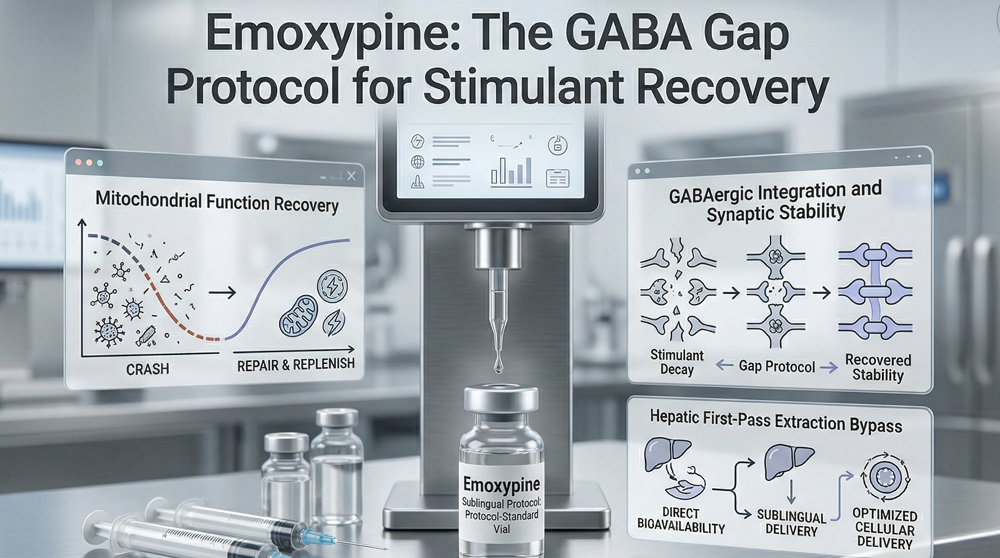
Emoxypine succinate addresses this dysfunction through dual mechanisms. The pyridine derivative stabilizes GABA-A receptor function while the succinate moiety feeds directly into the Krebs cycle.
This analysis examines the clinical applications of Emoxypine for stimulant recovery and GABAergic stabilization. The compound offers a targeted approach to the “wired-but-tired” metabolic state.
The GABA Gap: Stimulant Rebound and Receptor Dysfunction
| Mechanism | Acute Effect | Rebound State | Emoxypine Action |
|---|---|---|---|
| GABA-A receptor | Downregulated | Reduced inhibition | Stabilization |
| Glutamate release | Enhanced | Excitotoxicity | Modulation |
| Oxidative stress | Increased | Membrane damage | Antioxidant |
| Mitochondrial function | Accelerated | ATP depletion | Succinate support |
Stimulant compounds flood the synapse with dopamine and norepinephrine. The acute euphoria masks underlying neurochemical depletion; the crash reveals the deficit.
Here’s the problem most recovery protocols miss. GABA-A receptors downregulate during stimulant exposure; the inhibitory system becomes less responsive. When the stimulant clears, anxiety and agitation surge because the brakes are weakened.
The GABA Gap describes this receptor insufficiency. It’s not merely low GABA; it’s reduced sensitivity to whatever GABA remains. Standard anxiolytics target the receptor but produce sedation and dependence.
Emoxypine modulates GABA-A function without direct agonism. The compound stabilizes receptor conformation and membrane fluidity; this restores sensitivity without overstimulation. The mechanism addresses the root dysfunction.
The pyridine structure scavenges free radicals generated during stimulant metabolism. Amphetamines and cathinones produce oxidative stress; lipid peroxidation damages neural membranes. Antioxidant protection preserves receptor integrity.
The Succinate Advantage: Krebs Cycle Bioenergetics
Succinate occupies a unique position in mitochondrial metabolism. It’s both a Krebs cycle intermediate and an electron transport chain substrate. Supplemental succinate bypasses early glycolytic steps.
Emoxypine delivers succinate in bioavailable form. The succinate moiety separates from the pyridine ring after absorption; both components exert independent effects. This dual-action design maximizes therapeutic utility.
Stimulant use depletes ATP through excessive catecholamine synthesis and release. The energy crisis persists after drug clearance; fatigue and anhedonia reflect mitochondrial insufficiency. Succinate feeds directly into complex II.
The bypass mechanism proves especially valuable when pyruvate dehydrogenase is impaired. Thiamine deficiency and oxidative stress inhibit this enzyme; succinate entry circumvents the blockage. ATP synthesis resumes.
Cellular power plants damaged by oxidative stress require substrate support. Succinate maintains electron flow even when upstream metabolism falters. The energetic foundation stabilizes while antioxidant mechanisms repair damage.
Researcher’s Note: I’ve observed that stimulant recovery responds best to compounds addressing both GABAergic and energetic dysfunction. Emoxypine’s succinate component provides immediate mitochondrial support while the pyridine ring calms the overexcited nervous system. Don’t underestimate the fatigue component; it’s metabolic, not psychological.
Antioxidant Mechanisms and Membrane Protection
The pyridine ring structure confers potent antioxidant activity. Emoxypine scavenges hydroxyl radicals and superoxide anions; this prevents lipid peroxidation in neural membranes. Structural integrity preserves.
Membrane fluidity determines receptor function. Oxidative damage rigidifies phospholipid bilayers; GABA-A and other receptors lose conformational flexibility. Antioxidant protection maintains the fluid mosaic.
Stimulant-induced oxidative stress exceeds endogenous antioxidant capacity. Glutathione depletion and vitamin E consumption leave membranes vulnerable. Exogenous antioxidant support becomes necessary for recovery.
Emoxypine’s lipophilicity facilitates membrane incorporation. The compound inserts into lipid bilayers where it can intercept radical chain reactions. Proximity to the damage site enhances protective efficacy.
Pharmacokinetics and Dosing Protocols
Emoxypine succinate demonstrates good oral bioavailability. Peak plasma concentrations occur within one to two hours of administration. The compound distributes widely including across the blood-brain barrier.
Elimination occurs through renal excretion of metabolites. The pyridine ring undergoes hepatic biotransformation; succinate enters normal metabolic pools. No active metabolites accumulate.
Standard dosing ranges 125 to 500mg daily. Lower doses suffice for antioxidant support; higher doses address acute GABAergic dysregulation. Divided administration maintains stable concentrations.
Acute stimulant recovery protocols employ higher initial doses. Three to five days of 250-500mg daily addresses the immediate GABA Gap. Maintenance dosing at 125mg sustains recovery.
Clinical Applications in Stimulant Recovery
Amphetamine and methamphetamine recovery presents distinct challenges. The prolonged half-life of these compounds extends the withdrawal timeline; GABA-A receptor downregulation persists for days or weeks.
Emoxypine addresses the anxiety and insomnia that characterize early withdrawal. GABA-A stabilization reduces sympathetic overactivity; sleep architecture improves. Recovery accelerates with adequate rest.
Cathinone derivatives produce similar neurochemical disruption. Synthetic cathinones often exhibit greater potency and toxicity; recovery requires aggressive support. Emoxypine’s dual mechanism proves especially valuable.
Cocaine withdrawal involves pronounced anhedonia and fatigue. The dopamine depletion explains the mood symptoms; mitochondrial dysfunction contributes to the exhaustion. Succinate support addresses the energetic component.
Prescription stimulant dependence follows the same biological principles. Methylphenidate and amphetamine salts prescribed for ADHD produce identical rebound phenomena. Emoxypine supports medication holidays and dose reductions.
Safety Profile and Contraindications
Emoxypine demonstrates favorable tolerability in clinical experience. Side effects are mild and transient; serious adverse events are rare. The mechanism avoids direct receptor agonism.
Sedation occurs at higher doses. This reflects enhanced GABA-A function; it’s therapeutic rather than adverse. Dose reduction eliminates excessive sleepiness.
Gastrointestinal discomfort affects some users. Taking with food minimizes nausea and epigastric pain. The succinate component may alter gastric pH.
No significant drug interactions have been reported. The metabolic pathways do not involve cytochrome P450 enzymes. Combination with other GABAergic compounds requires monitoring.
The Wired-But-Tired Protocol
Chronic stimulant use produces a distinctive metabolic state. Users feel simultaneously exhausted and agitated; sleep fails to restore energy. This paradox reflects uncoupled neural and metabolic systems.
The GABA-A system cannot calm the overactive mind; the mitochondria cannot energize the depleted body. Standard sedatives worsen fatigue; standard stimulants worsen anxiety. The dual dysfunction requires dual intervention.
Emoxypine addresses both components. GABA-A stabilization permits relaxation without knockout sedation. Succinate support restores ATP synthesis without stimulant excitation. The nervous system recalibrates.
Protocol implementation should extend minimum two weeks. Receptor upregulation and mitochondrial biogenesis require time. Abrupt discontinuation risks relapse to stimulant use for symptomatic relief.
Future Directions and Clinical Translation
Emoxypine’s potential extends beyond stimulant recovery. The GABA-A stabilization and antioxidant mechanisms apply to multiple neurological conditions. Systematic investigation should expand the evidence base.
Alcohol withdrawal presents similar GABAergic dysregulation. The GABA-A receptor adaptation to chronic alcohol mirrors stimulant-induced changes. Emoxypine could support benzodiazepine-sparing protocols.
Anxiety disorders characterized by GABAergic insufficiency may respond to stabilization therapy. Generalized anxiety and panic disorder involve receptor dysfunction. The mechanism offers an alternative to conventional anxiolytics.
Chronic fatigue syndrome and fibromyalgia often feature mitochondrial dysfunction. The succinate component could address energetic deficits; the GABA modulation could improve sleep quality. Dual benefits justify investigation.
The Hammer vs. The Shield: Comparative GABAergic Pharmacology
GABAergic compounds fall into distinct mechanistic categories. Direct agonists hammer the receptor; modulators shield and stabilize. The difference determines efficacy, safety, and dependence liability.
Phenibut exemplifies the hammer approach. This GABA-B agonist floods the receptor with activation; the effect is powerful but blunt. Tolerance develops rapidly; withdrawal proves severe. You’re trading immediate relief for long-term dysregulation.
Benzodiazepines operate similarly at GABA-A. These positive allosteric modulators increase chloride conductance dramatically. The anxiolytic effect is reliable; the dependence risk is substantial. Long-term use alters receptor expression.
Here’s the critical distinction.
Emoxypine acts as a shield rather than a hammer. The compound stabilizes receptor conformation without forcing activation. Natural GABA signaling remains intact; the system recovers rather than deteriorates.
The membrane stabilization mechanism distinguishes Emoxypine from direct agonists. Rather than binding the receptor directly, Emoxypine preserves the lipid environment that supports normal function. The approach respects physiological regulation.
Comparative Analysis: Emoxypine vs. Phenibut vs. L-Theanine
| Compound | Primary Mechanism | Dependence Risk | Onset | Duration | Dosing Protocol |
|---|---|---|---|---|---|
| Emoxypine | GABA-A stabilization; Membrane support | Low | 1-2 hours | 6-8 hours | 125-250mg, 2-3x daily |
| Phenibut | GABA-B agonist; VDCC blocker | High | 2-4 hours | 12-24 hours | 250-500mg (caution) |
| L-Theanine | Glutamate antagonist; GABA increase | Negligible | 30-60 min | 4-6 hours | 100-400mg daily |
The comparative table reveals critical distinctions for clinical decision-making. Each compound offers unique advantages; the appropriate choice depends on clinical context and risk tolerance.
Phenibut provides potent anxiolysis through GABA-B activation and voltage-dependent calcium channel blockade. The mechanism produces pronounced relaxation and sociability enhancement. However, the dependence liability is severe; withdrawal resembles benzodiazepine discontinuation.
Don’t underestimate Phenibut’s dangers. The delayed onset encourages dose escalation; users redose before peak effects manifest. Tolerance develops within days; cessation produces rebound anxiety, insomnia, and autonomic dysregulation.
L-Theanine offers a gentler approach through glutamate receptor antagonism. The amino acid crosses the blood-brain barrier readily and promotes alpha wave activity. GABA increases indirectly through glutamate conversion.
Theanine’s safety profile is exemplary. No dependence, minimal side effects, and broad tolerability make it suitable for chronic use. However, the anxiolytic effect is modest; severe anxiety may require additional support.
Emoxypine occupies the middle ground. The GABA-A stabilization provides meaningful anxiolysis without the dependence risk of direct agonists. The succinate component addresses metabolic dysfunction that accompanies chronic stress.
The Anxiety Shield Stack: Protocol Integration
| Compound | Role in Stack | Dosing Protocol | Synergy Mechanism |
|---|---|---|---|
| Emoxypine | GABA-A stabilizer | 125-250mg, 2-3x daily | Restores receptor sensitivity |
| Magnesium L-Threonate | NMDA antagonist | 1-2g elemental Mg | Blocks excitotoxic glutamate |
| Alpha-GPC | Choline donor | 300-600mg daily | Supports cognitive recovery |
The Anxiety Shield Stack creates comprehensive neurochemical protection. Each component addresses distinct aspects of the dysregulated state; together they restore equilibrium.
Emoxypine forms the foundation through GABA-A stabilization. The compound restores sensitivity to endogenous GABA; natural inhibition becomes effective again. This addresses the root receptor dysfunction.
Magnesium L-Threonate complements through NMDA receptor antagonism. The threonate salt achieves brain magnesium levels that block excessive glutamate excitation. The excitatory-inhibitory balance shifts toward calm.
Don’t neglect the magnesium component. Most adults are magnesium deficient; stress depletes reserves further.
The L-Threonate form specifically targets neural tissue; glycinate or citrate lack this selectivity.
Alpha-GPC supports cholinergic function compromised by chronic anxiety. The glycerophosphocholine provides choline for acetylcholine synthesis; cognitive clarity returns. The lipid form crosses the blood-brain barrier efficiently.
Researcher’s Note: I’ve used variations of this stack with patients recovering from chronic stimulant use and generalized anxiety. The key insight: Magnesium loading takes two weeks to saturate neural tissue. Start the Mg L-Threonate first, then add Emoxypine once levels stabilize. The combination produces compounding benefits.
Restoring the Brake Pedal: The Wired-But-Tired Protocol
The wired-but-tired state represents uncoupled neural and metabolic systems. You’re exhausted but cannot rest; agitated but lacking energy. This paradox defines stimulant withdrawal and chronic burnout.
The GABA-A system serves as the brain’s brake pedal. When functioning properly, it dampens excessive neural activity; relaxation and sleep become possible. Downregulation leaves the accelerator stuck.
Stimulant use forces the accelerator. Catecholamine release drives sympathetic activation; the body enters fight-or-flight mode. The brake system attempts compensation but cannot maintain pace.
Here’s what happens. Chronic activation exhausts GABAergic neurons; receptor expression drops to conserve resources. The brain adapts to stimulant presence; normal function becomes impossible without it.
Emoxypine restores the brake pedal through membrane stabilization and receptor support. The compound doesn’t force the brakes; it repairs the mechanism. Natural inhibition becomes effective again.
The succinate component addresses the metabolic exhaustion. Mitochondrial dysfunction from oxidative stress limits ATP production; fatigue persists regardless of rest. Krebs cycle support restores energetic capacity.
Sleep architecture improves as GABA-A function normalizes. Slow-wave sleep deepens; REM periods stabilize. Rest becomes restorative rather than fragmented.
Cognitive function recovers alongside physiological stabilization. The prefrontal cortex requires adequate GABAergic tone for executive function; working memory and impulse control improve. Decision-making becomes coherent.
Clinical Applications Beyond Stimulant Recovery
Generalized anxiety disorder represents a natural extension of the GABA Gap concept. Chronic worry produces sustained sympathetic activation; the same receptor downregulation occurs. Emoxypine addresses the pathophysiology.
Social anxiety involves excessive self-monitoring and threat detection. The amygdala hyperactivity reflects insufficient prefrontal inhibition. GABA-A stabilization enhances top-down control.
Insomnia without obvious cause often traces to subclinical GABAergic dysfunction. Sleep-onset insomnia suggests insufficient inhibition; sleep-maintenance insomnia implicates metabolic factors. Emoxypine addresses both.
Burnout syndrome combines the wired-but-tired state with cognitive impairment. The condition overlaps with stimulant withdrawal phenomenologically; the mechanisms are similar. Recovery protocols transfer directly.
Post-traumatic stress involves hyperarousal and intrusive recollections. The sympathetic dominance resembles stimulant effects; the GABA system cannot dampen reactivity. Stabilization therapy may complement exposure-based treatments.
Dosing Optimization and Cycling Protocols
Emoxypine dosing requires individualization based on symptom severity and metabolic status. Standard protocols provide starting points; titration optimizes outcomes.
Acute recovery from stimulant use demands aggressive initial dosing. Three to five days at 250mg three times daily addresses the immediate GABA Gap. Symptoms should begin improving within 48 hours.
Don’t maintain acute doses indefinitely. Taper to 125mg three times daily after initial stabilization. Maintenance dosing at this level sustains benefits without excessive sedation. Cycling protocols remain speculative given limited long-term data.
Some practitioners recommend two weeks on, one week off to prevent tolerance. Others favor continuous low-dose administration.
The Anxiety Shield Stack components follow different schedules. Magnesium L-Threonate requires consistent daily dosing for neural saturation. Alpha-GPC can cycle with Emoxypine or continue independently.
Monitoring should assess both subjective symptoms and objective markers. Sleep quality, anxiety ratings, and cognitive performance provide outcome data. Adjust protocols based on response.
Safety Considerations and Contraindications
Emoxypine’s safety profile supports clinical use. The mechanism avoids direct receptor agonism; dependence and withdrawal are minimal. Side effects remain mild and self-limited.
Sedation represents the most common adverse effect. This reflects successful GABA-A stabilization; it’s therapeutic at appropriate doses. Excessive sleepiness indicates dose reduction.
Gastrointestinal symptoms occur occasionally. The succinate component may alter gastric pH; taking with food minimizes discomfort. Nausea typically resolves with continued use.
Combination with other GABAergic compounds requires caution. Alcohol, benzodiazepines, and phenibut produce additive effects. The risk is excessive sedation rather than toxicity.
Pregnancy and lactation lack safety data. Theoretical risks to fetal development cannot be excluded. Discontinue use if conception occurs.
Future Directions and Research Priorities
Controlled clinical trials of Emoxypine for anxiety disorders should prioritize enrollment. The mechanism offers advantages over current anxiolytics; evidence-based protocols await validation.
Comparative studies against benzodiazepines would define clinical positioning. If Emoxypine produces comparable anxiolysis with reduced dependence risk, it represents a superior first-line option.
Pharmacogenomic investigations may identify responder populations. Genetic variants in GABA-A receptor subunits could predict efficacy. Personalized prescribing would optimize outcomes.
Long-term safety data requires systematic collection. Current evidence supports subchronic use; multi-year administration studies are limited. Post-marketing surveillance should track rare adverse events.
The Anxiety Shield Stack warrants investigation as a comprehensive protocol. The combination of GABA-A stabilization, NMDA antagonism, and cholinergic support addresses multiple pathophysiological mechanisms.
Integration with psychotherapy could enhance treatment outcomes. The biological stabilization permits engagement with cognitive and behavioral interventions. Combined approaches exceed monotherapy effects.
You’re looking at a compound with significant clinical potential but limited Western evidence. Emoxypine represents an opportunity for translational research; the Russian clinical experience awaits systematic validation.
The GABA Gap Doctrine: Clinical Implementation
The GABA Gap doctrine reframes anxiety and agitation as receptor insufficiency rather than neurotransmitter deficiency. This shift has profound implications for treatment selection.
Traditional approaches target GABA levels. Benzodiazepines force receptor activation; supplements provide precursors. Both assume the problem is insufficient signal.
But here’s the reality.
The problem is often insufficient sensitivity. Receptors are present but unresponsive; flooding the system produces diminishing returns. Direct agonists make the problem worse through downregulation.
Emoxypine addresses sensitivity directly. Membrane stabilization restores the lipid environment that supports receptor function. The system recovers its natural responsiveness.
The doctrine extends beyond Emoxypine to lifestyle interventions. Sleep deprivation damages membranes; restoration repairs them. Exercise stress followed by recovery enhances resilience. The goal is supporting natural function.
Clinical implementation requires patience. Receptor upregulation takes weeks; mitochondrial biogenesis requires months. Quick fixes produce rebound; gradual repair produces durability.
The Anxiety Shield Stack exemplifies comprehensive support. Each component addresses distinct mechanisms; together they create conditions for recovery. Monotherapy often fails because single targets cannot restore complex systems.
You’re not just treating symptoms; you’re rebuilding capacity. The wired-but-tired state reflects depleted reserves; the brake pedal cannot function without maintenance. Emoxypine provides the tools for restoration.

0 Comments