
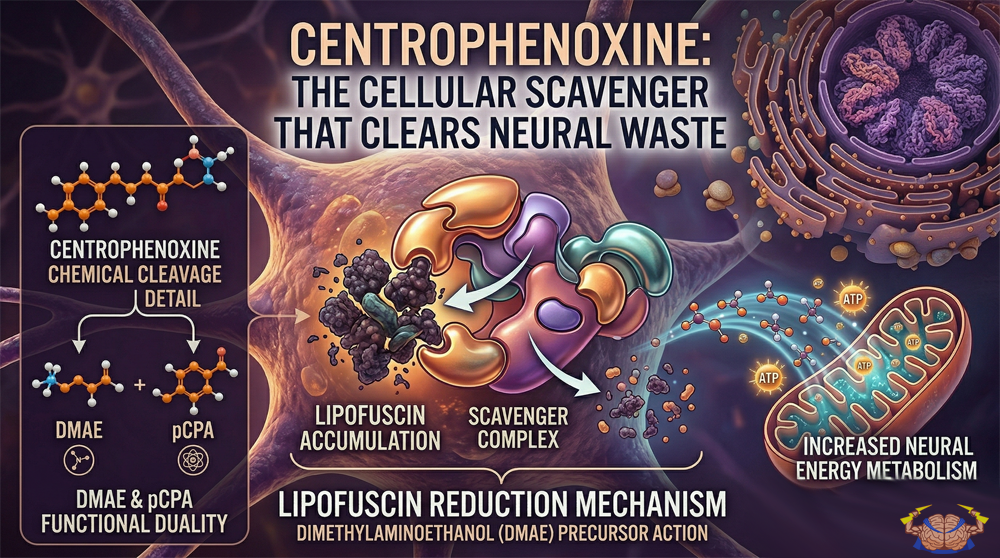
Aging neurons accumulate garbage. Centrophenoxine is the cleanup crew.
Centrophenoxine, also known as Meclofenoxate or by the brand name Lucidril, represents a synthetic cholinergic compound developed for cognitive maintenance. The molecule was synthesized in France in 1959 by the French National Scientific Research Center for Alzheimer’s patients experiencing memory decline.
The chemical structure comprises two esters: DMAE and parachlorophenoxyacetate. This dual composition creates unique pharmacokinetic properties that distinguish it from standard choline sources.
The mechanism centers on cellular waste clearance and cholinergic enhancement. These dual pathways address both structural maintenance and neurotransmitter support. Unlike acute cognitive enhancers, Centrophenoxine produces gradual benefits through sustained cellular repair. The compound preserves neural function rather than temporarily spiking performance.
The racetam community has embraced Centrophenoxine as a foundational anchor compound. Its sustained choline delivery prevents the depletion headaches common to aggressive nootropic protocols.
This article examines Centrophenoxine through the lens of clinical data and mechanistic research. The cellular scavenger offers distinct advantages for long-term neural health.
The Blood-Brain Barrier Advantage
Standard DMAE faces significant obstacles reaching neural tissue.
The blood-brain barrier restricts entry of polar molecules. DMAE crosses slowly and incompletely.
Centrophenoxine solves this problem through structural innovation. The parachlorophenoxyacetate bond facilitates passage across the blood-brain barrier.
This enhanced penetration delivers meaningful concentrations to neural tissue. Brain levels exceed those achievable with equivalent DMAE doses. The pharmacokinetic advantage translates directly to clinical efficacy. Lower peripheral doses produce greater central effects.
Once across the barrier, Centrophenoxine undergoes metabolic cleavage. The ester bond releases DMAE and parachlorophenoxyacetate.
The liberated DMAE supports acetylcholine synthesis. The metabolic fate mirrors DMAE supplementation but with superior delivery efficiency. For researchers seeking neural maintenance, this penetration is critical. Peripheral choline availability matters little if the compound never reaches the brain.
The cellular scavenger designation reflects this delivery advantage. Centrophenoxine actually reaches the cells requiring cleanup.
The Lipofuscin Protocol: Cellular Waste Clearance
Lipofuscin is a brown wear-and-tear pigment that accumulates in aging neurons.
This undigested residue comprises oxidized lipids, proteins, and metals. The material clogs lysosomes and impairs cellular function.
Accumulation progresses steadily without intervention. Aging neurons become increasingly burdened by this waste.
Centrophenoxine stimulates lysosomal enzyme activity. The compound enhances breakdown of accumulated lipofuscin. Research demonstrates potent cellular scavenger activity. Treated neurons show substantial reduction in age pigment content.
In a three-month study, mice dosed with Centrophenoxine demonstrated massive decreases in neuronal lipofuscin. The clearance was significant compared to untreated controls.
The mechanism involves enhanced lysosomal acid hydrolase activity. These digestive enzymes break down the accumulated material.
Additionally, Centrophenoxine appears to increase lysosomal number. More organelles are deployed for waste processing.
The clinical data is promising but requires realistic interpretation. Lipofuscin clearance is partial rather than complete.
Reversal of decades of accumulation is unlikely. The goal is slowing further buildup and achieving partial clearance.
Animal studies correlate reduced lipofuscin with improved neuronal function. Mice demonstrated superior performance in the when dosed with Centrophenoxine for those 3 months.
The cognitive benefits appear linked to cellular cleanup. Waste removal preserves neural processing capacity.
Human data remains limited but consistent. Available evidence supports the animal findings. The lipofuscin protocol demands long-term commitment. Benefits emerge gradually over months of sustained use.
The cellular scavenger works persistently. Patience is required for meaningful structural improvement.
What about the mice who did NOT receive it?
Compared to the counterpart group of mice that did not receive Centrophenoxine, the former group resolved hurdles with more ease and also showed a decrease in neuronal lipofuscin.
Lipofuscin is a ‘wear and tear’ pigment and its deposition in the brain increases with age!
Centrophenoxine aids the process of
Along with boosting memory amongst old aged individuals, this nootropic also showed an increase in!
The has been observed in a study where they both worked in harmony to promote learning and memory, even when the brain had been impaired by shock!
Cholinergic Mechanisms: Frontal Lobe Acetylcholine
Centrophenoxine decreases acetylcholinesterase activity in the frontal lobe.
This enzyme normally breaks down acetylcholine. Inhibition prolongs cholinergic signaling.
The effect raises acetylcholine levels in the frontal cortex. Executive functions depend on this neurotransmitter.
Working memory and attention particularly benefit from cholinergic enhancement. The prefrontal region receives dense cholinergic innervation.
Centrophenoxine supports this innervation through dual mechanisms. Precursor supply meets enzyme inhibition. The sustained release maintains steady-state acetylcholine levels. Spikes and crashes are avoided.
This steady support suits maintenance rather than acute enhancement. The brain adapts to consistent availability.
The effect is milder than pharmaceutical cholinesterase inhibitors. Centrophenoxine avoids the side effects of donepezil or rivastigmine.
Long-term potentiation in hippocampal circuits also depends on acetylcholine. Memory formation requires cholinergic modulation. The frontal lobe focus distinguishes Centrophenoxine from general cholinergics. Specific regional targeting enhances executive function.
Clinical observation shows improved mental clarity with chronic use. Subjective benefits align with the mechanistic understanding.
Neuroprotection and Antioxidant Activity
Centrophenoxine boosts antioxidant enzymes and shows neuroprotective properties.
The compound stimulates antioxidant enzyme quantity and activity. This defense often declines with age. Chronic cerebral ischemia responds to Centrophenoxine treatment. The compound alleviates cognitive decline from reduced blood flow.
Research demonstrates efficacy in vascular cognitive impairment. Brain perfusion improvements correlate with functional benefits.
The neuroprotective mechanism extends beyond cholinergic support. Cellular protection operates through multiple pathways.
Synergy with Rhodiola Rosea has been documented. The combination promotes learning and memory even when the brain has been impaired by shock.
This adaptogenic pairing addresses stress-induced cognitive deficits. The mechanisms complement each other.
Antioxidant support protects against oxidative damage. This prevents formation of additional lipofuscin. The combination of clearance and prevention addresses aging comprehensively. Existing waste is removed; new accumulation is slowed.
Neuroprotection in the context of cerebral ischemia is clinically relevant. Vascular cognitive impairment affects many elderly individuals.
Centrophenoxine offers a non-prescription option for vascular brain health. The mechanism differs from pharmaceutical interventions.
Centrophenoxine vs. Alpha-GPC: Acute vs. Maintenance
These compounds serve different therapeutic purposes.
Alpha-GPC delivers choline for immediate cognitive spikes. The effects are rapid and noticeable.
Users experience acute enhancement within hours. The phospholipid form crosses the blood-brain barrier efficiently.
Centrophenoxine produces more gradual cholinergic support. The DMAE release is slower and sustained.
Acute effects are subtler. Users may not feel immediate enhancement.
However, the long-term profile differs significantly. Alpha-GPC provides transient spikes of cholinergic tone. Centrophenoxine supports slow, long-term neural maintenance and structural repair. The sustained delivery maintains steady-state levels.
For acute cognitive demands, Alpha-GPC is superior. The rapid onset matches immediate task requirements.
For structural neural maintenance, Centrophenoxine is preferred. The sustained support preserves function over time. The lipofuscin clearance adds a dimension Alpha-GPC cannot match. No cleanup function exists with phospholipid choline sources.
Centrophenoxine offers both cholinergic support and waste removal. This dual action justifies selection for maintenance protocols. Dosing differs between compounds. Alpha-GPC is effective at lower milligram amounts.
Centrophenoxine requires higher doses due to metabolic conversion. The bioavailability is lower but the central delivery is superior.
The cost profile also differs. Centrophenoxine is generally less expensive per dose than phospholipid forms.
For researchers building maintenance stacks, Centrophenoxine offers distinct value. The combination of mechanisms is unique among choline sources.
The SuperMindHacker Protocol: The Racetam Anchor
Racetam protocols demand substantial acetylcholine support.
These compounds enhance glutamatergic transmission significantly. Acetylcholine demand increases proportionally.
Without adequate choline support, racetam users experience headaches. The depletion signals presynaptic distress.
Centrophenoxine serves as the racetam anchor. The sustained choline delivery prevents depletion.
Consider modulating AMPA and NMDA receptors within the racetam framework for comprehensive enhancement. The combination optimizes cognitive performance.
Begin with Centrophenoxine alone at one thousand milligrams daily. Establish individual tolerance. After one week, add the racetam of choice. Piracetam at standard doses or Aniracetam provide cognitive enhancement.
Monitor for headaches during the first days. Absence indicates adequate choline support. If headaches emerge, increase Centrophenoxine dose. The additional choline resolves depletion symptoms.
Some users require higher Centrophenoxine doses with aggressive racetam cycling. Individual variation is substantial. The timing of administration matters. Centrophenoxine should accompany or precede the racetam dose.
This sequencing ensures choline availability when demand spikes. Presynaptic stores remain stocked.
Cycling is less critical for Centrophenoxine than for stimulants. The compound supports rather than depletes.
However, periodic breaks of one week monthly allow receptor recovery. The cholinergic system benefits from rest periods. The racetam anchor protocol emphasizes prevention. Adequate choline prevents problems rather than treating symptoms.
Clinical Dosing and Pharmacokinetics
Standard dosing ranges from two hundred fifty to one thousand milligrams daily.
The half-life is approximately four to eight hours. Divided dosing maintains stable levels. Up to three thousand milligrams is used in cases of severe cognitive decline. Higher doses require medical supervision.
The compound is fat-soluble and must be taken with a meal. Dietary fat enhances absorption significantly.
Morning and early afternoon dosing optimizes benefits. Evening administration may disrupt sleep.
The cholinergic stimulation is alerting. Late doses interfere with sleep onset. Individual titration identifies optimal dosing. Start low and increase gradually.
Assess response at each dose level before escalating. Steady-state requires several days.
Track cognitive function monthly. Benefits accumulate gradually. Subjective markers include mental clarity and reduced brain fog. These indicate successful lipofuscin clearance.
Maintain consistent supplementation. Sporadic use limits structural benefits.
The cellular scavenger requires sustained presence. Regular administration enables meaningful cleanup.
Safety Profile and Contraindications – Is Centrophenoxine Safe?
Centrophenoxine demonstrates favorable safety at recommended doses.
Common side effects include insomnia if taken late in the day. The cholinergic stimulation disrupts sleep.
Initial headaches or mild nausea can occur. These typically resolve as tolerance develops.
Taking doses earlier prevents sleep disruption. Morning administration is optimal.
Excessive dosing produces cholinergic toxicity symptoms. Nausea and bradycardia indicate overdose.
Pregnant women should avoid Centrophenoxine. Safety data for pregnancy is lacking.
Minors should not use this compound. The developing brain requires caution. Those with epilepsy should avoid cholinergic agents. Seizure threshold may be affected.
Bipolar disorder represents a contraindication. Mood stability may be compromised. Drug interactions are minimal. Centrophenoxine does not significantly affect cytochrome P450 enzymes.
Other cholinergic agents may produce additive effects. Combine with appropriate caution.
Overall, Centrophenoxine is well-tolerated for chronic use. Decades of human consumption support the safety profile.
Historical Development and Modern Applications
Centrophenoxine emerged from mid-twentieth century French pharmaceutical research.
The French National Scientific Research Center synthesized the compound in 1959. The target population was Alzheimer’s patients with cognitive decline.
The brand name Lucidril became recognized across Europe. Marketing emphasized memory and cognitive support. Early clinical trials examined dementia populations. Results supported cholinergic enhancement and metabolic improvement.
The advent of acetylcholinesterase inhibitors overshadowed development. Donepezil and similar compounds became standard treatments. Centrophenoxine remained available but less prominent. The nootropic community rediscovered its value in the twenty-first century.
Contemporary use emphasizes longevity and maintenance rather than acute treatment. The compound fits preventive health paradigms.
The cellular scavenger mechanism distinguishes Centrophenoxine from modern pharmaceuticals. No prescription option offers equivalent lipofuscin clearance.
Research into lysosomal enhancement continues. Centrophenoxine represents an early entry in this therapeutic category.
The combination of cholinergic support and waste removal remains unique. No other available compound matches this profile.
Integration with Comprehensive Protocols
Centrophenoxine fits within broader cognitive enhancement strategies.
The racetam anchor role is primary for many users. Choline depletion prevention enables aggressive nootropic cycling.
Antioxidant supplements complement the mechanism. Reduced oxidative damage slows lipofuscin formation.
Mitochondrial support compounds enhance cellular energy. Better ATP production supports lysosomal function. Adaptogens like Rhodiola Rosea show documented synergy. The combination addresses stress-impaired cognition. Caloric restriction mimetics may enhance autophagy. The combination of enhanced clearance and reduced formation is optimal.
Monitor biomarkers when possible. Inflammatory markers and oxidative stress indicators assess protocol effectiveness.
Subjective tracking remains valuable. Mental clarity and memory function provide practical feedback. The cellular scavenger requires patience. Structural benefits emerge gradually over months.
Consistency outperforms intensity. Regular administration enables meaningful neural maintenance.
For researchers seeking long-term preservation, Centrophenoxine offers distinct value. The compound addresses aging at the cellular level.
The Chemistry of Parachlorophenoxyacetate
The pCPA moiety contributes unique pharmacological properties.
This acid has independent biological activity. The effects complement the cholinergic action.
The combination produces comprehensive neuroprotection. Enhanced cholinergic tone meets cellular cleanup.
The ester bond cleaves after blood-brain barrier penetration. This releases both active components.
The metabolic timing ensures sustained availability. Gradual release prevents spikes and crashes.
The pCPA component may have weak stimulant properties. This adds to the alerting effects.
However, the primary mechanism remains cholinergic. The pCPA contribution is secondary.
The dual release creates prolonged activity. The four to eight hour half-life reflects this.
For researchers, understanding the chemistry matters. The structure determines the function.
Comparative Analysis: Pharmaceutical vs. Nutritional
Centrophenoxine occupies a unique regulatory position.
Pharmaceutical cholinesterase inhibitors require prescriptions. Donepezil and rivastigmine are controlled.
Centrophenoxine is available as a nutritional supplement. The regulatory status differs significantly. However, the mechanism overlaps with pharmaceuticals. Both increase cholinergic tone.
The milder effect of Centrophenoxine is advantageous. Side effects are reduced.
Patients seeking alternatives to prescriptions explore this compound. The accessibility appeals.
Physicians may not be familiar with this option. The research literature is older. For self-directed researchers, Centrophenoxine offers autonomy. Personal experimentation is possible.
The compound bridges pharmaceutical and nutritional categories. This hybrid status is unique.
Long-Term Structural Benefits
Centrophenoxine produces changes visible at the cellular level.
Electron microscopy reveals reduced lipofuscin granules. The lysosomes appear less burdened.
These structural improvements translate to function. Cellular efficiency increases.
The brain requires maintenance like any organ. Neural tissue benefits from cleanup. Aging is not merely chronological. Biological aging involves cellular deterioration.
Centrophenoxine addresses biological aging mechanisms. The cellular scavenger slows deterioration. The frontal lobe particularly benefits. Executive function depends on healthy neurons.
Memory consolidation requires intact circuits. The hippocampus and cortex both benefit. Structural maintenance preserves cognitive reserve. This reserve buffers against decline.
Practical Sourcing Considerations
Quality varies significantly between suppliers.
Centrophenoxine should be pure without fillers. Reputable sources provide certificates of analysis.
The compound is stable at room temperature. Special storage is not required.
Capsule form is most common. Powder is available for precise dosing. European suppliers often provide pharmaceutical-grade material. Quality exceeds basic supplement standards.
Price comparisons reveal significant variation. Higher cost does not always indicate better quality. Third-party testing provides assurance. Independent verification matters.
Researchers should verify purity before use. Contaminants undermine benefits. The investment in quality optimizes outcomes. Cellular maintenance deserves premium materials.
Where Can I Buy Centrophenoxine?
Luckily, this nootropic is available as an over-the-counter supplement in the USA and Canada.
However, in some regions of Europe and Japan, one might need a prescription to purchase Centrophenoxine.
You can buy centrophenoxine online here. This is by far the best quality / cheapest option for buying centrophenoxine online in my opinion.
However, you can also purchase Centrophenoxine on Amazon. >> Click here to compare options on Amazon.
Synergies with Other Nootropics
Beyond racetams, Centrophenoxine pairs with various compounds.
You can purchase racetams online here.
Noopept may benefit from choline support. The racetam derivative increases metabolic demand.
Modafinil users report enhanced smoothness with Centrophenoxine. The combination reduces jitteriness. Adaptogenic herbs complement the mechanism. Ashwagandha and Bacopa both support neural health.
Antioxidant supplements enhance the protective effects. Vitamin E and alpha-lipoic acid are common pairings.
The combination of cleanup and protection is powerful. Multiple mechanisms address aging.
However, complexity should match experience. Beginners should start simply.
Each addition should be tested individually. Isolate effects before combining. The racetam anchor remains the primary synergy. Other combinations are secondary.
Monitoring and Optimization
Systematic tracking guides protocol refinement. Subjective scales assess mental clarity. Daily ratings identify patterns.
Objective cognitive tests measure attention. Working memory tasks provide metrics.
Sleep quality indicates appropriate timing. Poor sleep suggests late dosing. Headache frequency reveals choline adequacy. Absence confirms sufficient support. Mood stability matters for long-term use. Cholinergic agents can affect emotion.
Energy levels reflect metabolic support. Sustained energy indicates benefit.
Documentation enables optimization. Data-driven adjustments outperform guesswork. The goal is sustainable enhancement. Long-term health outweighs short-term gains.
Future Research Directions
Centrophenoxine research continues evolving.
Modern imaging could visualize lipofuscin non-invasively. Magnetic resonance spectroscopy shows promise.
Genetic factors may predict responsiveness. Pharmacogenomic studies are needed. Optimal dosing for specific populations remains undefined. Age and sex may influence requirements.
Combination with modern pharmaceuticals warrants study. Synergies with donepezil are unexplored.
The lysosomal enhancement mechanism deserves attention. Similar compounds may be developed.
Long-term cohort studies would clarify benefits. Decades of follow-up are required. The cellular scavenger concept extends beyond choline. Other nutrients may enhance lysosomes. Centrophenoxine remains the prototype. Future compounds will build on this foundation.
The Molecular Biology of Lysosomal Function
Lysosomes are the cellular recycling centers.
These organelles contain acid hydrolases that digest macromolecules. The acidic pH is essential for enzyme activity.
Autophagy delivers damaged material to lysosomes. The process maintains cellular health. Lipofuscin accumulates when digestion is incomplete. The indigestible material remains.
Centrophenoxine appears to enhance lysosomal acidification. Better acidity improves enzyme function. The compound may also increase lysosomal biogenesis. More organelles process more waste.
Transcription factors like TFEB regulate lysosomal genes. Centrophenoxine may activate these pathways. The molecular details remain under investigation. The clinical effects are established.
Understanding the mechanism guides use. Rational application optimizes benefits.
Clinical Populations and Specific Applications
Certain populations may benefit particularly from Centrophenoxine.
Older adults with cognitive concerns are primary candidates. The lipofuscin clearance addresses age-related changes. Individuals with vascular risk factors may benefit. The cerebral ischemia protection is relevant.
Chronic fatigue patients report improved clarity. The cholinergic support addresses common symptoms. Students seeking maintenance rather than spikes may prefer this compound. Sustained support suits studying.
Professionals in demanding cognitive roles use Centrophenoxine. The sustained attention supports performance.
However, healthy young adults may notice less dramatic effects. The benefits are subtle and structural.
The compound shines in preservation rather than enhancement. Aging prevention outweighs acute boosts. Targeted use maximizes value. Appropriate candidates achieve meaningful benefits.
Regulatory Status and Global Availability
Centrophenoxine availability varies by jurisdiction.
European markets have longer histories with this compound. Lucidril remains available in some regions.
United States regulations classify it as a supplement. The Dietary Supplement Health and Education Act applies.
Quality control is the responsibility of manufacturers. FDA oversight is limited. Consumers must verify purity independently. Third-party testing provides assurance. Import restrictions may apply in some countries. Customs regulations vary. Travelers should check local laws. International transport requires caution.
The regulatory landscape continues evolving. Stay informed about changes. Responsible use respects local regulations. Compliance ensures continued availability.

0 Comments