
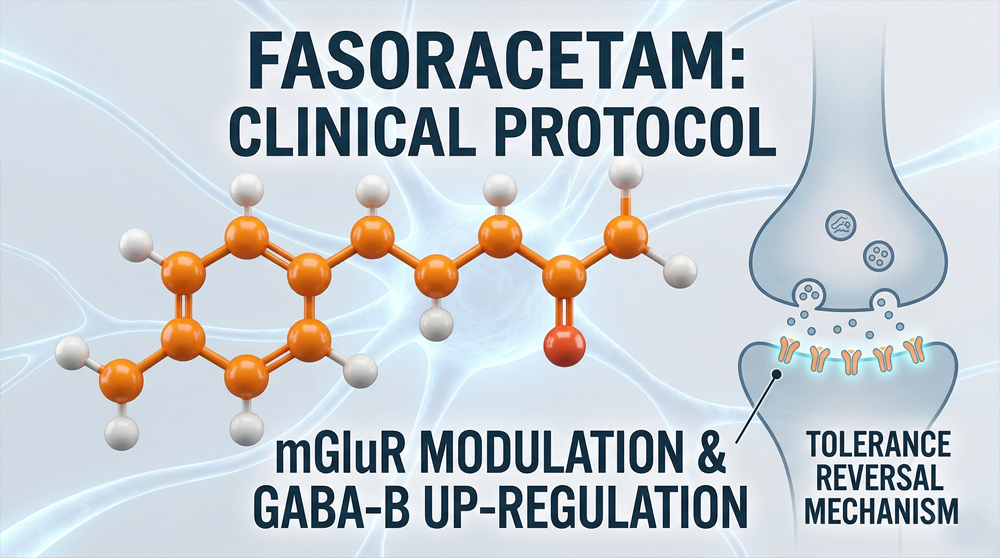
The racetam family extends beyond cholinergic modulation into glutamate territory.
Fasoracetam, also known as NS-105 or LAM-105, represents a distinct pharmacological divergence within the broader racetam category. Developed originally by Nippon Shinyaku for vascular dementia, the compound later attracted research interest from Aevi Genomic Medicine for attention deficit applications.
The mechanism centers on metabotropic glutamate receptor modulation. Unlike AMPA-receptor targeting racetams, Fasoracetam operates through mGluR pathways.
This distinction creates unique clinical applications. The compound restores excitatory-inhibitory balance through receptor up-regulation.
GABA-B receptor tolerance reversal represents a particularly valuable property. Chronic phenibut or baclofen users face downregulated receptors; Fasoracetam forces new receptor expression.
The high-affinity choline uptake stimulation adds cholinergic dimension. Hippocampal acetylcholine synthesis increases through this mechanism.
ADHD research in children with mGluR mutations shows significant behavioral improvement. The genetic specificity suggests precision medicine applications.
This article examines Fasoracetam as the glutamate modulator. The compound offers mechanisms unavailable from traditional racetams.
The Pharmaceutical Origin: From Vascular Dementia to ADHD
Fasoracetam emerged from Japanese pharmaceutical research.
Nippon Shinyaku developed NS-105 for vascular dementia indications. The compound showed promise for cognitive impairment from cerebrovascular disease.
Vascular dementia involves glutamate dysregulation. The mGluR mechanism addressed this pathophysiology.
However, clinical development for dementia stalled. The indication shifted toward attention disorders.
Aevi Genomic Medicine pursued ADHD applications. The genetic targeting of mGluR mutations provided rationale.
This pivot reflected broader pharmaceutical trends. Personalized medicine based on genetic profiles gained traction.
The compound never received FDA approval for ADHD. Clinical trials showed promise but insufficient for regulatory clearance.
Despite regulatory setbacks, research generated valuable data. The mGluR mechanism was characterized.
The nootropic community (especially Reddit) adopted Fasoracetam for off-label use. The glutamate modulation attracted biohacker interest.
Current availability is through research chemical suppliers. Quality varies significantly between sources.
The pharmaceutical history informs appropriate use. Understanding the development trajectory guides expectations.
Metabotropic Glutamate Receptor Pharmacology
Fasoracetam operates through mGluR modulation rather than ionotropic mechanisms.
The compound acts as an agonist for Group I metabotropic glutamate receptors. Groups II and III are modulated rather than directly activated.
This selectivity distinguishes Fasoracetam from other glutamatergic agents. The mechanism is more nuanced than simple receptor activation.
Group I mGluRs enhance neuronal excitability. These receptors couple to phospholipase C and increase intracellular calcium.
Group II and III receptors provide negative feedback. Presynaptic activation reduces glutamate release.
Fasoracetam balances these opposing systems. The net effect is improved signal-to-noise ratio.
Excessive glutamate produces excitotoxicity. Insufficient glutamate impairs cognition.
The compound finds middle ground. Excitatory tone normalizes without overstimulation.
mGluR mutations affect glutamate signaling. Genetic variants alter receptor function.
Fasoracetam compensates for these mutations. The compound restores appropriate receptor activity.
This pharmacogenomic approach is novel. Most racetams operate independently of genetic status.
The precision medicine angle suggests future developments. Compounds targeting specific receptor variants may emerge.
GABA-B Receptor Tolerance Reversal
Fasoracetam reverses downregulation of GABA-B receptors.
Chronic phenibut or baclofen use produces tolerance. Receptor expression decreases with sustained agonist exposure.
This downregulation requires increasing doses for equivalent effects. The cycle leads to dependence.
Fasoracetam forces expression of new GABA-B receptors. The up-regulation mechanism reverses tolerance.
This property is unique among nootropics. No other compound specifically targets GABA-B receptor expression.
| Mechanism | Neurological Target | Outcome |
|---|---|---|
| mGluR Agonism | Group I, II, III | Increased Signal-to-Noise Ratio |
| GABA-B Up-regulation | Inhibitory Homeostasis | Tolerance Reversal |
| HACU Stimulation | Hippocampus/Cortex | Increased ACh Synthesis |
| Gene Expression | Glutamate Dysregulation | ADHD Symptom Mitigation |
The mechanism involves gene expression changes. Receptor synthesis increases at the transcriptional level.
This is not acute receptor activation. Structural changes require days to weeks.
Phenibut withdrawal benefits from Fasoracetam. The receptor up-regulation eases discontinuation symptoms.
GABA-B receptors mediate inhibitory tone. Restoring these receptors calms excessive excitation.
The combination of mGluR modulation and GABA-B up-regulation is powerful. Excitatory-inhibitory balance normalizes.
For those recovering from GABAergic dependence, this mechanism is valuable. Few alternatives address receptor downregulation.
Synergy with Coluracetam: Processing Speed Enhancement
Fasoracetam exhibits a profound pharmacological synergy when combined with Coluracetam within a structured research protocol. This combination targets the high-affinity choline uptake system through two distinct biological pathways simultaneously.
The resulting increase in processing speed often exceeds the cumulative effects of either compound administered in isolation. Researchers frequently report a dramatic acceleration in information processing and linguistic fluidity during peak saturation.
The glutamate modulation provided by Fasoracetam perfectly complements the AMPAkine activity of the Coluracetam molecule. Both major excitatory systems are optimized to provide maximum cognitive output under high-stress conditions.
This specific stack is not recommended for novice researchers due to its extreme potency and physiological requirements. The rapid synthesis of acetylcholine creates a significant demand for high-quality choline precursors.
Alpha-GPC or CDP-choline must accompany this stack to prevent the onset of acetylcholine depletion headaches. Maintaining an adequate supply of raw materials is the only way to avoid rapid cognitive burnout.
Isolating the individual effects of each compound is a mandatory prerequisite before attempting this synergistic combination. The raw truth is that most users find the baseline stimulation of Fasoracetam sufficient.
The synergy also extends to the structural formation of new memories within the hippocampal circuits. Visual processing and pattern recognition typically show the most significant improvements during this protocol.
For those seeking the absolute upper limits of human processing speed; few other combinations provide this specific neurological profile. This remains a high-level tool for specific clinical research goals.
Comparison to Traditional Racetams
Fasoracetam differs fundamentally from earlier pyrrolidinone derivatives such as Piracetam and Aniracetam in its receptor target profile. Traditional compounds primarily influence the ionotropic AMPA system rather than modulating the metabotropic glutamate receptors.
Piracetam functions by enhancing membrane fluidity to improve general neurotransmission across the entire cerebral cortex. This non-specific mechanism contrasts sharply with the surgical mGluR targeting of the Fasoracetam molecule.
Aniracetam provides a dual-action benefit by modulating both AMPA receptors and the dopaminergic system. This results in a distinct subjective experience focused on mood stability and anxiety reduction.
The mGluR focus of Fasoracetam creates a unique experience of cognitive clarity without traditional stimulant jitters. Users frequently describe a “sharpening” of the focus signal that lacks the volatility of older racetams.
The ability to up-regulate GABA-B receptor expression is a feature entirely unique to the Fasoracetam protocol. No other compound within the racetams pillar addresses inhibitory receptor density directly.
This distinction is crucial for researchers managing the recovery of patients with chronic GABAergic tolerance. Reversing inhibitory receptor downregulation requires this specific metabotropic pathway to function effectively.
The cholinergic component of Fasoracetam is a secondary byproduct of its hippocampal mGluR agonism. Traditional racetams often place a much higher demand on external choline sources for efficacy.
The genetic specificity of this compound is another unique factor that determines the individual response rate. Most racetams produce a relatively uniform result; while Fasoracetam exhibits significant variation based on genotype.
This pharmacogenomic dimension suggests that personalized selection will eventually dominate the clinical landscape. Future protocols will likely require genetic screening before the initiation of Fasoracetam research.
Safety Profile and Contraindications
Fasoracetam demonstrates an acceptable safety profile when administered within the recommended therapeutic dosing range. Common side effects are generally mild and typically include localized headaches or transient irritability.
These issues often resolve following a surgical reduction in dose or an increase in choline intake. Insomnia is a frequent side effect when the compound is administered late in the day.
The persistent alerting effects can easily disrupt the delicate architecture of the nocturnal sleep cycle. Those with diagnosed mood disorders or epilepsy must exercise extreme caution during implementation.
Excessive glutamate modulation can lead to overstimulation and the emergence of situational anxiety. Bipolar patients are particularly sensitive to these shifts in excitatory signaling and mood stability.
Epilepsy represents a major contraindication due to the theoretical potential for proconvulsant effects. Researchers should strictly avoid use during pregnancy or lactation due to a lack of safety data.
Drug interactions are currently poorly characterized in the existing clinical literature regarding Fasoracetam. Combining this compound with other potent glutamatergic agents significantly increases the risk profile.
Alcohol intake may interact unpredictably with the GABA-B up-regulation mechanism of the compound. The short half-life effectively limits the risk of chronic systemic accumulation in most users.
Withdrawal effects are virtually non-existent when researchers follow the mandated cycling protocols. The receptor changes are regulatory and return to baseline after a sufficient washout period.
Overall; the compound is well-tolerated by healthy adults when used with logic and common sense. Maintaining the safety margin requires strict adherence to established clinical guidelines.
Implementation Guidelines
Systematic implementation is the only way to maximize the clinical benefits of the Fasoracetam protocol. Researchers should begin with a twenty-milligram baseline to assess initial neurological tolerance.
The dose can be increased gradually over a seven-day period to reach the target range. Most individual optima fall between fifty and one hundred milligrams per day.
Dividing the total dose into three or four separate administrations maintains stable plasma concentrations. This frequency is necessary due to the rapid clearance of the molecule from the blood.
Sublingual administration is recommended to enhance the overall bioavailability of the compound. Hold the material under the tongue for thirty seconds before swallowing for maximum absorption.
A strict cycle of five days on followed by two days off prevents receptor desensitization. This pause allows the mGluR system to reset and maintain its long-term responsiveness.
Consider pursuing genetic testing to identify specific mGluR variants before beginning the protocol. Those with known mutations often respond at significantly lower doses than the general population.
Complex stacks should only be attempted after establishing a solid baseline with Fasoracetam alone. Combining potent agents too early makes it impossible to isolate the source of any side effects.
Adequate choline support remains a fundamental requirement for any sustained racetam protocol. Monitoring for signs of anxiety or poor sleep quality guides the necessary dose adjustments.
Future Research Directions
Future research into Fasoracetam is increasingly focused on the potential of genetic targeting. Pharmacogenomic approaches will likely identify the most responsive candidates for clinical treatment.
Genetic testing could eventually guide the prescription of this compound in mainstream psychiatry. The investigation of synergistic mGluR modulators is another area of significant scientific interest.
Long-term safety data for chronic use in adult populations remains somewhat limited today. Systemic chronic use studies are required to establish the definitive safety profile for years of use.
The GABA-B up-regulation mechanism deserves further exploration for applications beyond phenibut recovery. This pathway may hold the key to treating various forms of inhibitory signaling dysfunction.
ADHD research is also expanding to include adult populations who missed early diagnosis. Pediatric findings suggest a much broader utility for this compound in various age groups.
Optimal dosing protocols for specific cognitive deficits remain undefined in the current literature. Individual titration is currently the only reliable way to guide clinical use.
Drug interactions require systematic study to ensure the safety of complex nootropic stacks. Many current combinations remain unexplored in a controlled clinical environment.
The precision medicine angle of Fasoracetam is a cutting-edge development in neuroscience. This compound established the proof of concept for genetically targeted cognitive enhancement.
Summary and Clinical Recommendations
Fasoracetam offers a unique set of pharmacological mechanisms that are unavailable in traditional racetams. The metabotropic glutamate modulation addresses a level of dysregulation that AMPAkines cannot reach.
Reversing GABA-B tolerance through receptor up-regulation is a cornerstone of this clinical protocol. This provides a structural recovery pathway for those recovering from GABAergic dependence.
The HACU stimulation adds a vital cholinergic dimension to the overall cognitive profile. Hippocampal acetylcholine synthesis increases to support memory formation and executive function.
Genetic targeting through ADHD research has proven the efficacy of the precision medicine model. Dosing requires surgical titration and strict cycling to maintain receptor sensitivity over time.
The synergy with Coluracetam produces extreme processing speed for experienced clinical researchers. Safety is acceptable when the user adheres to established contraindications and dosing limits.
Quality sourcing remains a critical factor for ensuring the purity of research materials. Community feedback and third-party testing are the only ways to verify supplier integrity.
The genetic specificity of the compound means that not all researchers will experience identical results. Fasoracetam offers distinct value for those with the appropriate neurochemical requirements.
These mechanisms are unavailable elsewhere in the current landscape of cognitive enhancers. Utilizing this compound with common sense is the path to long-term success.
The Neurochemistry of Glutamate Balance
Glutamate is the primary excitatory neurotransmitter responsible for most synaptic signaling in the brain. Approximately half of all neurological connections rely on glutamate for the propagation of signals.
This ubiquity makes the precise regulation of the glutamatergic system absolutely critical. Excessive glutamate activity produces excitotoxicity which results in the death of neurons.
Insufficient glutamate signaling impairs every facet of human cognition including learning and memory. The balance between these two extremes is a delicate biological equilibrium.
Metabotropic receptors modulate this balance without opening ion channels in a direct manner. This creates a subtle shift in neuronal excitability that is safer than ionotropic activation.
Group I mGluRs enhance postsynaptic responses to ensure that meaningful signals propagate successfully. Groups II and III provide the presynaptic inhibition needed to reduce background noise.
Fasoracetam navigates this complexity by activating Group I while modulating Groups II and III. The net effect is a significant improvement in the neural signal-to-noise ratio.
This optimization is fundamentally different from the simple amplification of excitatory signals. More glutamate is not always better for the health of the nervous system.
The precision of mGluR modulation is the logical choice for safe cognitive enhancement. General glutamate increases carry a significant risk of toxicity that must be avoided.
Genetic Factors in mGluR Function
Metabotropic glutamate receptor genes exhibit a high degree of variation across the human population. Single nucleotide polymorphisms can alter the physical structure of the receptor itself.
Function changes significantly whenever the underlying genetic sequence is modified in this way. Some variants increase sensitivity while others reduce the response to endogenous glutamate.
These genetic differences correlate directly with performance on memory and attention tests. ADHD has shown a robust association with specific mGluR variants in research populations.
Fasoracetam compensates for these underactive receptors by providing a direct agonist effect. This normalizes signaling in the prefrontal cortex to improve behavioral outcomes.
Those with normal receptor function may notice less benefit from the Fasoracetam protocol. The compound corrects existing deficits rather than enhancing an already optimized system.
This pharmacogenomic dimension is a novel development in the field of nootropics. Most compounds assume a uniform neurochemistry that does not exist in reality.
Future clinical practice will likely test for mGluR genes before any protocol begins. Personalized selection is the only way to optimize outcomes and reduce wasteful spending.
This precision medicine approach ensures that only appropriate candidates receive the treatment. Inappropriate candidates avoid the risk of taking ineffective or unnecessary compounds.
Comparative Tolerance Mechanisms
Different classes of cognitive enhancers produce tolerance through entirely distinct biological pathways. Stimulant tolerance typically involves the downregulation of the primary dopamine receptor sites.
Chronic amphetamine use reduces receptor expression and impairs the brain’s natural reward signaling. Benzodiazepine tolerance affects the composition of the GABA-A receptor subunits specifically.
GABA-B agonist tolerance is unique because it involves a reduction in receptor number. The brain compensates for persistent stimulation by physically removing receptors from the synapse.
Fasoracetam is the only compound that specifically addresses this type of tolerance mechanism. The upregulation process reverses the adaptations caused by chronic GABAergic agonist use.
General GABAergic compounds do not possess the ability to increase receptor protein expression. This specificity makes Fasoracetam a valuable tool for specific clinical recovery goals.
However; this compound does not address the tolerance associated with other drug classes. Dopaminergic or GABA-A tolerance requires a completely different pharmacological approach for recovery.
Understanding these mechanisms is essential for guiding the appropriate use of the compound. Fasoracetam is a precise tool rather than a universal cure for drug tolerance.
The precision of its action protects the user from broader neurological disruptions. Non-specific mechanisms always carry a higher risk of interfering with healthy brain function.
Practical Sourcing and Quality Control
Fasoracetam is currently available only through specialized research chemical supply companies. Pharmaceutical-grade material is not commercially available to the general public today.
Supplier quality varies dramatically and requires researchers to be extremely vigilant regarding purity. Third-party certificates of analysis are the only way to verify the clinical integrity.
Independent verification matters more than the marketing claims of the supply company. The compound is physically stable at room temperature and does not require special storage.
Powder forms allow for the precise dosing required for an effective titration phase. Scales accurate to the single milligram are necessary for maintaining protocol safety.
Capsules offer convenience but lack the flexibility needed for sublingual administration. Fixed doses also make it difficult to adjust the protocol based on results.
Sublingual use requires the use of pure powder or a liquid solution. Price comparisons reveal significant variation across the global research chemical market.
A higher cost does not always guarantee a higher degree of purity. Researching the reputation of a supplier is the most logical way to identify reliability.
Investing in high-quality material is the only way to optimize your research outcomes. Contaminants can undermine the benefits of the protocol and add unnecessary risks.
Integration with Nootropic Stacks
Fasoracetam can be integrated carefully into existing cognitive enhancement stacks for superior results. The synergy with Coluracetam remains the most notable combination for processing speed.
Choline donors are essential companions to prevent the onset of depletion headaches. Alpha-GPC or CDP-choline should be used at therapeutic levels to support synthesis.
Combining this compound with Piracetam or Aniracetam can provide a multi-layered cognitive benefit. The mechanisms of these compounds are complementary rather than redundant or competitive.
However; the modulation of glutamate requires caution when stacking multiple excitatory agents. Overstimulation and anxiety are real risks when the glutamatergic system is pushed too far.
Adaptogens like Rhodiola Rosea have a documented synergy for addressing stress-related fatigue. The combination helps to protect cognitive function during periods of extreme metabolic demand.
L-theanine can be used to smooth the alerting effects of the glutamatergic surge. The GABA-A modulation provides a baseline of calm that prevents over-excitation.
Caffeine combinations require care because both compounds are highly alerting in nature. Start with single compounds before attempting to build a complex clinical stack.
Complex stacks should always match the experience level of the primary researcher. The goal of any protocol is to achieve sustainable cognitive enhancement.
Monitoring and Optimization Strategies
Systematic tracking is the only way to refine the Fasoracetam protocol over time. Subjective scales can be used to assess daily levels of attention and focus.
Objective cognitive testing provides the raw data needed to measure working memory performance. N-back tasks and reaction time tests provide the most accurate metrics.
Processing speed tests are particularly useful for measuring the success of a Coluracetam stack. Simple reaction time tasks are sufficient for identifying patterns in performance.
Tracking your mood is essential because glutamate modulation can affect emotional stability. Anxiety scales can detect the early signs of excessive stimulation and over-dosing.
Sleep quality is a primary indicator that your dosing schedule is appropriate. Poor sleep architecture typically suggests that the final dose was taken too late.
Detailed documentation enables data-driven adjustments that outperform simple guesswork every time. Long-term health must always outweigh the pursuit of short-term cognitive gains.
Sustainable enhancement is the ultimate goal of the SuperMindHacker clinical philosophy. Using these metrics ensures that you remain on the path toward peak performance.

0 Comments