
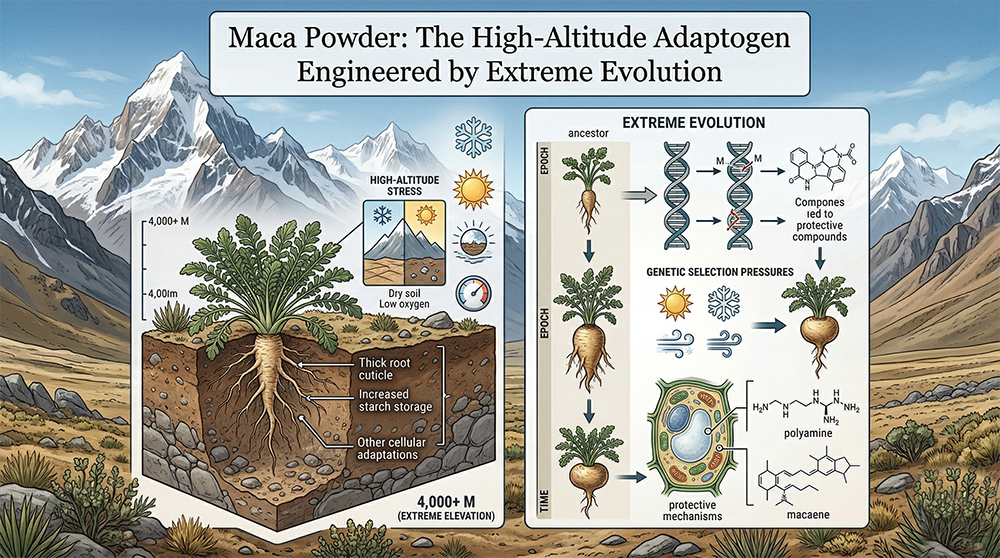
At fourteen thousand feet above sea level, a cruciferous root evolved molecular defenses that enhance human cognition. Research continues validating these mechanisms in human populations.
Maca, scientifically known as Lepidium meyenii, survived millennia of harsh Andean conditions. The plant developed unique bioactive compounds found nowhere else in nature.
These compounds, called macamides and macaenes, interact with human neurochemistry in remarkable ways. The high-altitude survivor offers cognitive benefits to those living at any elevation.
Three distinct phenotypes of Maca exist. Yellow, red, and black varieties each possess unique phytochemical profiles.
Black Maca emerges as the surgical choice for cognitive enhancement. Research consistently demonstrates superior effects on memory and learning.
The mechanism involves the endocannabinoid system. Macamides inhibit fatty acid amide hydrolase, the enzyme that breaks down anandamide.
This inhibition elevates endogenous cannabinoid levels. The bliss molecule anandamide persists longer in neural tissue.
The result is enhanced mood, reduced anxiety, and improved cognitive flexibility. The adaptogenic phenotype delivers multidimensional benefits.
Understanding Maca requires examining both traditional use and modern research. The convergence validates this Andean root as a serious cognitive tool.
This article presents Maca as the adaptogenic survivor. The high-altitude evolution created a unique neurochemical modulator.
Maca Powder – The High-Altitude Survivor: Three Phenotypes and Evolutionary Pressure
Maca evolved in the extreme environment of the Peruvian Andes. The adaptogenic effects support long-term cognitive health.
The plant grows at elevations exceeding four thousand meters. Intense ultraviolet radiation, freezing temperatures, and high winds shaped its biochemistry.
These environmental pressures selected for unique secondary metabolites. Macamides and macaenes represent evolutionary adaptations to oxidative stress.
The phenotypic variation in Maca reflects both genetic diversity and processing methods. Three primary colors dominate commercial availability.
Yellow Maca constitutes approximately sixty percent of the harvest. This variety offers general adaptogenic benefits but lacks the potency of darker phenotypes.
Red Maca represents roughly twenty-five percent of production. Research suggests particular benefits for prostate health and bone density.
Black Maca comprises only fifteen percent of the harvest. This rare phenotype shows the strongest cognitive effects.
The color differences reflect distinct phytochemical profiles. Black Maca contains higher concentrations of bioactive macamides.
Traditional Andean healers recognized these differences. Black Maca was reserved for royalty and elite warriors.
Modern research validates this traditional knowledge. Animal studies consistently show Black Maca outperforming other phenotypes on cognitive tasks.
The hypocotyl, the underground stem, contains the highest concentration of active compounds. Roots harvested after seven months of growth show optimal phytochemical content.
The drying process traditionally involves sun exposure. This dehydration concentrates the bioactive molecules.
Understanding the phenotypic differences guides selection. For cognitive enhancement, Black Maca is the unequivocal choice.
The evolutionary pressure that created Maca produced a unique adaptogen. The high-altitude environment engineered neurochemical modulators.
The Clinical Mechanism: Macamides, Macaenes, and the Endocannabinoid System
Maca’s cognitive effects operate through novel interactions with the endocannabinoid system. Understanding this pharmacology guides optimal supplementation.
The primary bioactive compounds are benzylated alkamides called macamides. These unique molecules are found only in Lepidium species.
Macaenes, unsaturated fatty acids, complement the macamide effects. Together these compounds modulate neural signaling.
The mechanism centers on fatty acid amide hydrolase inhibition. FAAH is the enzyme responsible for degrading anandamide.
Anandamide is the endogenous ligand for cannabinoid receptors. This neurotransmitter modulates mood, pain, appetite, and cognition.
Macamides bind to FAAH and temporarily inhibit its activity. The enzyme cannot break down anandamide at normal rates.
The result is elevated anandamide levels throughout neural tissue. The bliss molecule persists longer at cannabinoid receptors.
This elevation produces anxiolytic and mood-enhancing effects. Users report calm focus and emotional resilience.
The FAAH inhibition mechanism is subtle but significant. Unlike direct cannabinoid agonists, Maca preserves endogenous regulatory mechanisms.
The body maintains control over anandamide synthesis. Maca simply slows the breakdown of what the brain naturally produces.
This preservation of homeostasis distinguishes Maca from cannabis. The effects are milder but more sustainable.
Beyond the endocannabinoid system, Maca influences the hypothalamic-pituitary-adrenal axis. The adaptogen normalizes stress hormone responses.
Cortisol patterns improve with chronic Maca administration. The stress response becomes more appropriate and less exaggerated.
The hormonal effects extend to the hypothalamic-pituitary-gonadal axis. Maca supports reproductive hormone balance without directly supplying hormones.
This non-hormonal mechanism is crucial. Maca modulates endogenous production rather than replacing it.
The multiple mechanisms create comprehensive adaptogenic effects. Cognitive enhancement emerges from neurochemical, hormonal, and metabolic optimization.
The Cognitive Adaptogen: Memory, Processing, and Neuroprotection
Research increasingly validates Maca’s specific cognitive benefits. Research continues validating these mechanisms in human populations.
The cognitive adaptogen affects multiple domains of mental function. Memory, learning, and executive function all show improvement.
Black Maca and Social Recognition Memory
Social recognition memory depends on oxytocinergic and endocannabinoid systems. The adaptogenic effects support long-term cognitive health.
Black Maca enhances this specific form of memory through multiple pathways. The anandamide elevation modulates social bonding circuits.
Animal studies demonstrate improved social recognition following Black Maca administration. Rodents better distinguish familiar from novel conspecifics.
The mechanism involves oxytocinergic neuron activation in the hypothalamus. Maca compounds enhance oxytocin signaling.
Oxytocin supports social memory and bonding behaviors. The hormone modulates amygdala reactivity to social stimuli.
The enhancement of social cognition has practical implications. Improved social memory supports interpersonal relationships and professional networking.
The anandamide-oxytocin interaction represents a novel mechanism. Few other compounds target this specific pathway.
Human anecdotal reports support the animal data. Users describe enhanced social fluidity and connection.
The cognitive benefits extend beyond social domains. General spatial and recognition memory also improve.
The hippocampus shows enhanced neurogenesis with Maca treatment. New neuron formation supports memory consolidation.
The neurotrophic effects complement the endocannabinoid modulation. Multiple mechanisms converge on cognitive enhancement.
Gelatinization vs. Raw Root
The processing method dramatically affects Maca bioavailability and tolerability. The clinical implications extend to multiple physiological systems.
Raw Maca root contains starches that resist human digestion. The fiber content can produce gastrointestinal distress.
Traditional Andean consumption involved cooking the root. Heat processing breaks down indigestible starches.
Modern gelatinization mimics this cooking process. Extrusion heating removes starch content while preserving bioactive compounds.
Gelatinized Maca offers superior bioavailability. The macamides are more readily absorbed without competing starches.
The digestive tolerance improves dramatically. Users who experience bloating with raw Maca tolerate gelatinized forms well.
The concentration of active compounds increases. Removal of starch effectively concentrates the phytochemicals.
Standardized extracts offer further refinement. These products guarantee specific macamide content.
For researchers and biohackers, gelatinized Black Maca extract represents the optimal form. The balance of bioavailability and tolerability favors processing.
Raw Maca may appeal to purists. However, the traditional preparation involved cooking.
Gelatinization honors traditional wisdom while improving consistency. The processed form delivers reliable cognitive benefits.
Hormonal Feedback Loops and Perceived Clarity
Maca enhances mental clarity through HPA axis modulation without estrogenic effects. The adaptogenic effects support long-term cognitive health.
Unlike phytoestrogens, Maca does not bind estrogen receptors. The compound influences hormonal feedback without direct hormone mimicking.
The hypothalamic-pituitary-adrenal axis benefits from this modulation. Cortisol rhythms normalize with chronic Maca use.
Evening cortisol decreases while morning cortisol maintains appropriate levels. The stress response becomes more circadian-appropriate.
This normalization produces subjective mental clarity. Users report sustained energy without the wired sensation of stimulants.
The perceived clarity reflects genuine metabolic optimization. Mitochondrial function improves with Maca administration.
ATP production becomes more efficient. The brain receives adequate energy without excessive stress hormone stimulation.
The non-estrogenic mechanism distinguishes Maca from other adaptogens. Tribulus and other herbs work through different pathways.
This distinction matters for individuals concerned about hormone-sensitive conditions. Maca does not stimulate estrogen or testosterone production directly.
The mental stamina benefits accumulate over weeks. Acute effects are subtle; chronic benefits are substantial.
The adaptogenic phenotype emerges through consistent use. The body adapts to the support and functions more efficiently.
The SuperMindHacker Protocol: The Stamina Foundation
Optimal Maca utilization requires strategic combination with complementary adaptogens. Understanding this pharmacology guides optimal supplementation.
The Stamina Foundation strategy pairs Black Maca with Tongkat Ali for comprehensive neuro-endocrine support. This combination addresses multiple axes simultaneously.
Consult our clinical deep-dive into the hormonal and cognitive synergies of Tongkat Ali for detailed mechanism. Understanding this pharmacology guides optimal supplementation.
Tongkat Ali primarily affects the hypothalamic-pituitary-gonadal axis. The compound supports testosterone production through distinct mechanisms.
Maca complements this through HPA axis modulation. The combination optimizes both stress response and reproductive hormone balance.
The cognitive effects are synergistic. Maca’s endocannabinoid modulation combines with Tongkat Ali’s dopaminergic effects.
The SuperMindHacker Stamina Foundation recommends standardized Black Maca extract at two to three grams daily. This dose provides adequate macamide content.
Tongkat Ali is dosed at two hundred to four hundred milligrams of standardized extract. The combination provides comprehensive adaptogenic coverage.
Morning administration optimizes circadian hormone patterns. Both compounds support daytime energy and cognitive function.
Cycling is unnecessary for Maca. The adaptogen maintains effectiveness with chronic use.
Tongkat Ali may benefit from five days on, two days off cycling. This pattern prevents receptor adaptation.
The combination requires four to eight weeks for full effects. Adaptogenic benefits accumulate gradually.
Users should track subjective measures of stamina, clarity, and stress resilience. Objective measures might include reaction time or cognitive task performance.
The Stamina Foundation addresses the modern demand for sustained cognitive performance. The combination supports energy without depletion.
Implementation Guidelines
Systematic implementation maximizes Maca benefits while ensuring quality. Understanding this pharmacology guides optimal supplementation.
Source gelatinized Black Maca from reputable suppliers. Standardized extracts guarantee macamide content.
Begin with two grams daily taken in the morning. Assess tolerance and response over two weeks.
Increase to three grams if effects are subtle. Individual response varies based on metabolism and baseline status.
Combine with Tongkat Ali after establishing Maca tolerance. Introduce one compound at a time to assess individual effects.
Maintain consistent daily administration. Adaptogenic benefits require sustained exposure.
Monitor for side effects including insomnia, anxiety, or digestive upset. These are uncommon but possible.
Reduce dose or discontinue if adverse effects occur. Individual sensitivity varies.
Track cognitive function through objective testing. Working memory, processing speed, and stress resilience should improve.
Subjective markers include sustained energy, emotional balance, and mental clarity. These indicate successful adaptation.
The high-altitude survivor delivers consistent benefits. The evolutionary pressure that created Maca produced a unique cognitive tool.
Traditional Andean Use and Cultural Significance
Maca has sustained Andean civilizations for over two thousand years. The adaptogenic effects support long-term cognitive health.
The Inca empire valued Maca as both food and medicine. Imperial warriors consumed the root before battle.
Traditional preparation involved sun-drying and boiling. These processing methods enhanced bioactivity and reduced toxicity.
Spanish conquistadors documented Maca use among indigenous populations. The root was traded as currency.
Traditional healers prescribed Maca for fertility, stamina, and cognitive vigor. These applications align with modern research findings.
The three phenotypes served different purposes in traditional medicine. Yellow was for general use, red for blood disorders, and black for mental strength.
This traditional knowledge guided modern phenotype selection. Research validated the cognitive superiority of Black Maca.
The decline of Maca cultivation followed Spanish colonization. The crop was suppressed in favor of European imports.
Modern revival began in the 1980s. Scientists rediscovered the nutritional and medicinal properties.
Today Maca represents an important export for Peru. Cultivation has expanded while maintaining traditional methods.
The cultural heritage of Maca informs modern use. Traditional wisdom guides phenotype selection and preparation.
Phytochemical Composition and Standardization
Maca contains a complex mixture of bioactive compounds unique to the species. The clinical implications extend to multiple physiological systems.
Macamides represent the signature compounds of Maca. These benzylated alkamides are not found in other plants.
Over twenty distinct macamides have been identified. N-benzylhexadecanamide is the most abundant and studied.
Macaenes are unsaturated fatty acids that contribute to biological activity. These compounds work synergistically with macamides.
The phytochemical profile varies by phenotype and cultivation conditions. Altitude, soil quality, and harvest timing affect composition.
Standardized extracts specify macamide content. Quality products guarantee minimum concentrations.
The hypocotyl contains the highest concentration of active compounds. Root extracts are more potent than leaf extracts.
Polysaccharides in Maca provide additional adaptogenic benefits. These complex carbohydrates support immune function.
The protein content of dried Maca is substantial. Approximately ten to fourteen percent by weight supports nutritional applications.
Essential minerals including iron, copper, and zinc contribute to effects. The mineral profile supports metabolic function.
Vitamins B1, B2, and C are present in meaningful amounts. These micronutrients complement the unique macamides.
The comprehensive phytochemical profile explains Maca’s broad effects. No single compound accounts for all benefits.
Neuroprotective and Neurotrophic Mechanisms
Maca demonstrates neuroprotective properties through multiple pathways. Understanding this pharmacology guides optimal supplementation.
The antioxidant effects reduce oxidative stress in neural tissue. Free radical scavenging protects membranes and proteins.
Glutathione peroxidase activity increases with Maca administration. The endogenous antioxidant defense is enhanced.
Neurogenesis in the hippocampus is stimulated by Maca compounds. New neuron formation supports cognitive reserve.
Brain-derived neurotrophic factor expression increases with treatment. BDNF supports synaptic plasticity and survival.
The neuroprotective effects extend to ischemic injury. Maca pretreatment reduces infarct size in stroke models.
The mechanism involves anti-inflammatory and antioxidant actions. Multiple pathways converge on tissue protection.
Alzheimer’s disease models show reduced amyloid toxicity with Maca. The neuroprotection may slow neurodegeneration.
The endocannabinoid modulation contributes to neuroprotection. Anandamide has intrinsic antioxidant and anti-inflammatory properties.
Long-term Maca use may support brain aging. The multiple protective mechanisms address age-related decline.
Physical Performance and Energetic Effects
Maca enhances physical performance through mechanisms distinct from stimulants. The adaptogenic effects support long-term cognitive health.
The energizing effects do not produce the jitteriness of caffeine. Maca supports mitochondrial function without overstimulation.
ATP production becomes more efficient. The energetic benefits are sustainable rather than borrowed.
Endurance performance improves in human trials. Time to exhaustion increases with Maca supplementation.
The mechanism involves improved glucose utilization. Cells extract more energy from available substrate.
Oxygen consumption efficiency improves. The same work requires less metabolic cost.
Recovery from exercise accelerates. Reduced oxidative damage permits faster tissue repair.
The adaptogenic properties help the body respond to training stress. Overtraining risk may be reduced.
These physical benefits complement the cognitive effects. The body and mind function as an integrated system.
Reproductive Health and Hormonal Balance
Maca supports reproductive function without supplying exogenous hormones. Research continues validating these mechanisms in human populations.
The non-hormonal mechanism distinguishes Maca from testosterone replacement or phytoestrogens. The root modulates endogenous production.
Men experience improved sperm quality and libido. These effects occur without increasing testosterone levels directly.
Women experience improved menstrual regularity and menopausal symptom relief. The effects occur without estrogenic activity.
The hypothalamic-pituitary-gonadal axis is normalized. Feedback loops function more appropriately.
Fertility improves in both sexes. The mechanism involves enhanced cellular function rather than hormone provision.
The reproductive benefits may indirectly support cognition. Reproductive hormones influence neural function.
The non-specific mechanism makes Maca safe for hormone-sensitive conditions. Prostate and breast health are not adversely affected.
Safety Profile and Contraindications
Maca demonstrates an excellent safety profile at recommended doses. Research continues validating these mechanisms in human populations.
The root has been consumed as food for millennia. The safety margin is substantial.
Common side effects are mild and self-limited. Digestive upset occurs in sensitive individuals.
Gelatinized forms reduce gastrointestinal symptoms. The processing removes difficult-to-digest starches.
Insomnia may occur with evening dosing. Morning administration avoids this issue.
Individuals with thyroid conditions should exercise caution. Maca contains goitrogenic compounds.
Those with hormone-sensitive cancers should consult physicians. While Maca is not estrogenic, medical guidance is prudent.
Pregnancy and lactation lack adequate safety data. Conservative approaches suggest avoiding supplementation.
Drug interactions are minimal. Maca does not significantly affect cytochrome P450 enzymes.
Anticoagulant medications may theoretically interact. The vitamin K content is low but not zero.
Overall, Maca is well-tolerated by healthy adults. The adaptogenic profile supports rather than stresses physiological systems.
Future Directions in Maca Research
Maca research continues expanding into new therapeutic territories. The adaptogenic effects support long-term cognitive health.
Clinical trials for cognitive enhancement are underway. Formal human studies will validate traditional uses.
The endocannabinoid mechanism warrants further investigation. Selective FAAH inhibitors based on macamide structure are possible.
Neurodegenerative disease applications are being explored. The neuroprotective properties may have clinical utility.
Optimal dosing protocols require refinement. Current recommendations are based on traditional use and preliminary research.
Phenotype-specific applications will likely emerge. Red Maca for bone health, Black Maca for cognition.
Combination with other adaptogens requires systematic study. Synergies with Ashwagandha, Rhodiola, and others are likely.
The sustainability of Maca cultivation is important. Increasing demand must not deplete wild populations.
Organic cultivation methods are being developed. Quality control ensures product consistency.
The adaptogenic phenotype of Maca will continue evolving in research. The high-altitude survivor offers much to modern science.
Comparative Analysis: Maca vs. Other Adaptogens
Maca occupies a unique position among cognitive adaptogens. Understanding this pharmacology guides optimal supplementation.
Ashwagandha modulates the GABA system and reduces cortisol. The mechanism differs from Maca’s endocannabinoid focus.
Rhodiola enhances monoamine activity and ATP production. The energizing effects are more acute than Maca.
Ginseng improves mitochondrial function and nitric oxide signaling. The vascular effects distinguish it from Maca.
Maca’s FAAH inhibition mechanism is unique among major adaptogens. The endocannabinoid modulation offers distinctive benefits.
The combination of Maca with other adaptogens creates comprehensive coverage. Each compound addresses different aspects of stress response.
The Stamina Foundation with Tongkat Ali exemplifies this approach. Multiple axes are optimized simultaneously.
Individual response varies between adaptogens. Some users respond better to Maca; others prefer Ashwagandha or Rhodiola.
Trial of single compounds identifies personal responsiveness. Combinations can then be built around effective agents.
The adaptogenic category continues expanding. Maca represents one of the most scientifically interesting options.
Practical Sourcing and Quality Control
Maca quality varies dramatically between suppliers. Understanding this pharmacology guides optimal supplementation.
Authentic Peruvian Maca commands premium prices. Cheaper products may be adulterated or mislabeled.
Look for standardized extracts specifying macamide content. Reputable suppliers provide certificates of analysis.
Organic certification ensures absence of pesticide residues. The Andean growing regions are relatively pristine.
Gelatinization should be specified for digestive tolerance. Raw Maca is less bioavailable and more difficult to digest.
Phenotype should be clearly labeled. Black Maca commands higher prices due to rarity.
Some products blend phenotypes. These may be economical but lack the specific benefits of pure Black Maca.
Third-party testing for heavy metals is important. Roots can accumulate minerals from soil.
Storage conditions affect shelf life. Maca should be kept cool and dry to preserve active compounds.
The investment in quality Maca pays dividends in effectiveness. The adaptogenic benefits require authentic, properly processed material.
Integration with Lifestyle Factors
Maca supplementation complements other cognitive optimization strategies. The clinical implications extend to multiple physiological systems.
Sleep quality amplifies Maca’s benefits. The adaptogen supports recovery during rest.
Exercise enhances the energetic effects. Physical activity and Maca synergize for mitochondrial support.
Stress management practices complement the HPA axis modulation. Meditation and Maca address stress from different angles.
Nutritional adequacy supports Maca’s metabolic effects. The adaptogen works best when cofactors are available.
Hydration affects bioavailability. Adequate water intake supports absorption.
The comprehensive approach maximizes adaptogenic benefits. Maca is one component of cognitive optimization.
Tracking tools help identify optimal dosing. Subjective ratings of energy, clarity, and stress provide feedback.
Objective measures such as reaction time or cognitive task performance quantify benefits. The clinical implications extend to multiple physiological systems.
The high-altitude survivor integrates well into modern lifestyles. The ancient adaptogen meets contemporary demands.

0 Comments