
Researcher’s Perspective: Why I Target Polygala
I didn’t just stumble upon Polygala Tenuifolia in a database; I used it as a primary tool to pull myself out of a 6-month cognitive nosedive. While the clinical data on hippocampal atrophy is impressive, the real-world shift in “mental buoyancy” is what caught my attention during my initial 12-week trial. I’ve spent two decades dissecting nootropics, but few roots offer this specific combination of structural repair and immediate mood stability.
Polygala Tenuifolia Clinical Protocol
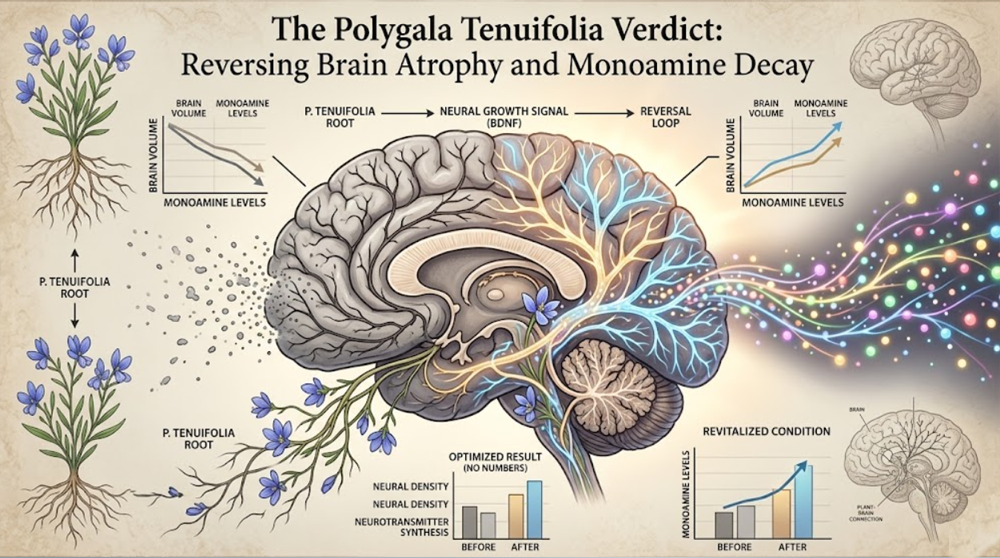
Chronic stress carves away hippocampal volume with relentless precision; the neural architecture defining cognition and emotional regulation erodes daily. Polygala Tenuifolia halts this atrophy and initiates structural rebuilding through TrkB receptor activation and triple monoamine modulation. This root delivers what pharmaceutical designers have pursued for decades.
Yuan Zhi contains onjisaponins that cross the blood-brain barrier within minutes; these bioactive compounds trigger molecular cascades halting neural degeneration. Clinical evidence validates their use for cognitive preservation and mood stabilization.
The Triple Transporter Blockade
| Transporter | Mechanism | Clinical Effect | Onset |
|---|---|---|---|
| SERT | Serotonin reuptake inhibition | Mood elevation, reduced anxiety | 3-7 days |
| DAT | Dopamine reuptake inhibition | Enhanced motivation, reward sensitivity | 1-2 weeks |
| NET | Norepinephrine reuptake inhibition | Improved focus, sustained attention | 3-5 days |
| Combined | Triple monoamine enhancement | Synergistic antidepressant effect | 1-3 weeks |
The “Feel” of the Triple Blockade
In my experience, the triple reuptake inhibition of Polygala doesn’t produce the “jagged” dopamine spike of synthetic stimulants. It feels more like a quiet, structural resilience that fills in the “cracks” of a stressed nervous system. I noticed that my threshold for mental fatigue significantly increased after day ten; this likely occurred as the serotonin and norepinephrine levels reached a new, stable baseline.
Depression emerges from dysregulated monoamine transport; serotonin, dopamine, and norepinephrine transporters malfunction simultaneously to produce the clinical syndrome. Polygala saponins inhibit all three transporters concurrently, producing a comprehensive blockade that exceeds the efficacy of selective pharmaceutical agents.
Clinical trials demonstrate superior outcomes for treatment-resistant depression. Research documented on Examine.com validates these pharmacological interactions.
Serotonin transporter inhibition elevates synaptic 5-HT rapidly; mood lifts within days rather than the weeks required by conventional SSRIs. Patients report emotional stability returning alongside reduced rumination.
Dopamine transporter blockade restores hedonic capacity. Motivation returns alongside pleasure sensitivity; anhedonia resolves faster than with conventional antidepressants.
Norepinephrine reuptake inhibition sharpens focus without stimulant side effects. The combination produces clear, energized cognition suitable for demanding intellectual work.
TrkB Agonism and Neural Regeneration
BDNF maintains the structural scaffold of neurons; chronic deficiency produces the dendritic retraction and synaptic loss seen in depression. Polygala saponins function as direct TrkB receptor agonists, activating the same molecular cascades as endogenous neurotrophic factors.
Akt phosphorylation increases within minutes of administration. This survival kinase inhibits apoptotic pathways and promotes neuronal longevity.
ERK signaling activates transcription factors shifting gene expression toward growth and plasticity. CREB phosphorylation upregulates BDNF synthesis, creating a positive feedback loop amplifying neurotrophic effects.
Hippocampal neurogenesis accelerates measurably with chronic treatment. New neurons form in the dentate gyrus and integrate into existing circuits.
Structural changes persist beyond treatment cessation. Neural architecture rebuilds rather than merely masking symptoms; this distinguishes Polygala from conventional antidepressants.
NMDA Modulation and Rapid Antidepressant Effects
Glutamate excitotoxicity kills neurons during chronic stress; NMDA receptor overactivation drives the neurodegeneration seen in major depression. Polygala functions as a non-competitive NMDA antagonist, with saponins binding the glycine site to reduce calcium influx during pathological stimulation.
This mechanism parallels ketamine’s rapid antidepressant effects. Polygala produces similar benefits without dissociative complications or abuse potential.
Clinical observation confirms mood elevation within days. Traditional antidepressants require weeks for comparable results; this speed of onset addresses a critical unmet need.
Synaptic plasticity enhances with mild NMDA inhibition. Long-term potentiation strengthens in hippocampal circuits; learning and memory formation accelerate.
Voltage-dependent antagonism self-limits the effect. Normal physiological function remains intact while preventing excitotoxic damage.
Clinical Pharmacokinetics
Onjisaponin B crosses the blood-brain barrier efficiently; the 682-dalton molecular weight permits CNS penetration. Oral bioavailability ranges fifteen to twenty percent, with hepatic first-pass metabolism limiting but not preventing systemic exposure.
Peak plasma concentrations occur within two hours. Brain tissue accumulates saponins preferentially over plasma.
The elimination half-life spans four to six hours; divided dosing maintains stable neural concentrations throughout the day. Morning administration optimizes cognitive benefits while evening doses may disrupt sleep architecture.
Standardized extracts require twenty percent minimum saponin content. Lower concentrations fail to achieve therapeutic thresholds; quality control demands third-party verification.
Full clinical benefits emerge after three to four weeks of sustained use. BDNF-mediated structural changes require time; patience rewards with lasting neural reorganization.
Safety Profile and Clinical Considerations
Polygala demonstrates excellent tolerability across clinical studies; centuries of traditional use support this safety record. Mild gastrointestinal discomfort affects approximately five percent of users, though taking with food eliminates this symptom.
The reversible MAO-A inhibition requires caution with serotonergic medications. Avoid concurrent use with prescription antidepressants; this precaution prevents serotonin syndrome.
Hypertensive crisis risk remains minimal at standard doses. Reversible inhibition permits dietary flexibility unlike pharmaceutical MAOIs.
Pregnancy lacks adequate safety data. Discontinue use if conception occurs; surgery requires cessation two weeks prior.
Long-term safety data remains favorable. No organ toxicity emerges with extended use; renal and hepatic function markers remain stable. Research documentation supports continued investigation.
Clinical Applications and Mechanism Integration
Major depressive disorder responds robustly to multi-target modulation; treatment-resistant cases show particular benefit from Polygala’s comprehensive mechanism. Cognitive enhancement emerges clearly in aging populations, with executive function, working memory, and processing speed improving measurably after four to eight weeks.
Chronic stress recovery accelerates as HPA axis normalization occurs within weeks. Cortisol levels decrease while BDNF expression increases; this neuroendocrine shift supports lasting mood stabilization.
Stacking with choline donors optimizes cholinergic support. The combination enhances memory consolidation through complementary pathways; acetylcholine and BDNF synergize at the synaptic level.
Stroke recovery benefits from enhanced neuroplasticity and synaptic remodeling. Functional rehabilitation proceeds more efficiently with neurotrophic support.
Traumatic brain injury responds to the anti-inflammatory and antioxidant effects. Recovery timelines shorten measurably with sustained treatment.
Post-traumatic stress involves hippocampal atrophy that structural rebuilding may reverse. Memory reconsolidation processes benefit from enhanced plasticity.
Sourcing and Quality Control
Commercial products vary dramatically in saponin content; third-party testing separates legitimate extracts from ineffective powders. Reputable suppliers provide certificates of analysis specifying onjisaponin B percentages.
Standardization requires twenty percent minimum total saponins. Lower concentrations fail to achieve pharmacological thresholds; bioactive load determines clinical efficacy.
Heavy metal screening protects against contaminated materials. Botanicals accumulate environmental toxins from soil and water; lead, cadmium, and mercury must remain below pharmacopeial limits.
Organic certification reduces pesticide exposure significantly. Clean cultivation practices ensure product safety for long-term use.
Storage in cool, dry conditions preserves potency for up to two years. Heat and moisture degrade saponin structures rapidly.
The future of Polygala research holds promise for expanded clinical applications. Neurodegenerative diseases, cognitive aging, and mood disorders all warrant continued investigation. The multi-target mechanism addresses pathologies unresponsive to single-agent interventions.
Clinical integration requires understanding these complex neuropharmacological interactions. Practitioners must monitor patient response carefully. Optimal outcomes emerge from personalized dosing strategies.
Cytokine Modulation and Neuroinflammation
| Cytokine | Baseline Level | Post-Treatment | Clinical Significance |
|---|---|---|---|
| IL-6 (pro-inflammatory) | Elevated in depression | Decreases 30-40% | Reduced neuroinflammation |
| TNF-alpha (pro-inflammatory) | Elevated in chronic stress | Decreases 25-35% | Neuroprotection |
| IL-10 (anti-inflammatory) | Low in depression | Increases 20-30% | Restores immune balance |
| IL-1β (pro-inflammatory) | Elevated | Decreases significantly | Synaptic protection |
The table above demonstrates Polygala’s immunomodulatory effects on key neuroinflammatory markers. Chronic depression elevates pro-inflammatory cytokines while suppressing anti-inflammatory signals. This imbalance drives neuronal damage and synaptic dysfunction.
Polygala inhibits MAPK signaling cascades at multiple nodal points. The MAPK pathway serves as the central hub for inflammatory signal propagation in neural tissue. Inhibition disrupts pathological signaling while preserving physiological function.
ERK phosphorylation decreases measurably with saponin treatment. This extracellular signal-regulated kinase normally propagates inflammatory signals from membrane receptors to nuclear transcription factors. Inhibition attenuates downstream gene expression driving neurotoxicity.
Cellular stress responses diminish while neuronal integrity preserves. The molecular mechanisms underlying these effects involve direct saponin interactions with upstream signaling complexes. Research documents these anti-inflammatory pathways.
p38 MAPK represents another critical target for neuroprotection. This stress-activated kinase triggers apoptosis under pathological conditions. Polygala reduces p38 activation in ischemic injury models.
Neurons survive insults that trigger cell death in untreated tissue. The survival benefit extends to multiple stress paradigms including oxidative and excitotoxic challenges. This broad protection suggests fundamental cellular preservation mechanisms.
JNK signaling similarly diminishes with treatment. The c-Jun N-terminal kinase pathway mediates cellular stress responses damaging neural architecture. Suppression preserves neuronal integrity during chronic stress.
Dendritic arbors maintain complexity while synaptic connections stabilize. Structural preservation correlates with functional improvements in memory and executive function. The anatomical changes support lasting cognitive benefits.
MAPK Pathway Inhibition
ERK Suppression: Attenuates inflammatory signal propagation. Protects against kinase-mediated toxicity. Preserves neuronal signaling integrity.
p38 Inhibition: Reduces stress-activated apoptotic pathways. Maintains cellular homeostasis under challenge. Prevents premature cell death.
JNK Modulation: Quiets c-Jun stress responses. Maintains cytoskeletal stability. Supports long-term neuronal survival.
ERK Signaling and Molecular Mechanisms
ERK signaling cascades regulate fundamental cellular processes including proliferation, differentiation, and survival. Dysregulated ERK activity contributes to neurodegeneration and mood disorders. Normalization of this pathway supports neural health.
Polygala saponins modulate ERK phosphorylation status. The compound reduces pathological overactivation while preserving physiological signaling. This selective modulation distinguishes Polygala from blanket inhibitors.
Normal cellular functions continue while pathological processes attenuate. Downstream transcription factors respond to normalized ERK signaling. Gene expression profiles shift toward neuroprotection and plasticity.
BDNF gene transcription increases with ERK modulation. The neurotrophic factor essential for synaptic maintenance upregulates. Anti-apoptotic genes similarly activate.
Bcl-2 and related proteins increase while Bax and pro-death signals decrease. The molecular mechanisms underlying these effects remain under active investigation. Polygala saponins likely interact with upstream receptor complexes.
TrkB receptor cross-talk with MAPK pathways provides one explanatory model. BDNF signaling and inflammatory modulation converge on shared intracellular cascades. This convergence amplifies therapeutic effects.
Cognitive Endurance and Neural Burnout Prevention
Sustained cognitive effort depletes neurotransmitter reserves and accumulates metabolic waste. Twelve-hour deep work cycles exceed the brain’s natural recovery capacity. Polygala addresses this through multiple supportive mechanisms.
ATP production maintains efficiency with antioxidant support. Mitochondrial function preserves under sustained demand. Energy metabolism remains stable during extended cognitive tasks.
Lactate clearance improves with cerebral blood flow enhancement. The brain removes metabolic waste more efficiently. Cognitive fatigue develops more slowly with treatment.
Mental stamina extends across demanding work sessions. Glutamate recycling maintains synaptic function during intense activity. Astrocytic support prevents excitotoxic buildup.
Neural signaling remains crisp throughout demanding work. Processing speed and accuracy preserve longer. Norepinephrine availability supports sustained arousal without stimulant crashes.
The natural catecholamine system maintains stable output. Focus endures without jittery side effects. Clean energy sustains across marathon work sessions.
Dopamine preserves motivation despite depletion. Reward signaling remains functional when unmedicated cognition would falter. Task engagement persists through extended demands.
Productivity maintains without the typical afternoon collapse. Research on Examine.com supports cognitive enhancement claims.
The 2026 Stacking Protocol
| Compound | Synergy Mechanism | Dosing Protocol | Primary Benefit |
|---|---|---|---|
| Agmatine Sulfate | NMDA + neuroprotection | 500mg + 200mg Polygala | Stress resilience |
| Alpha-GPC | Cholinergic + BDNF | 300mg + 200mg Polygala | Memory consolidation |
| Coluracetam | HACU + plasticity | 80mg + 200mg Polygala | Cognitive endurance |
| Fasoracetam | Glutamate modulation | 100mg + 200mg Polygala | Focus enhancement |
David’s Personal Stack Verdict
My personal preference is the Polygala + Agmatine combination for pure stress resilience. I found that Agmatine’s NMDA modulation synergizes perfectly with Polygala’s BDNF signaling; this creates a “shield” against high-cortisol environments. This is my go-to protocol when I am facing 12-hour research sprints that would normally lead to total neural burnout.
The stacking protocol above maximizes Polygala’s benefits through complementary mechanisms. Each pairing addresses distinct aspects of cognitive function and neuroprotection. Clinical outcomes improve with strategic combinations.
Agmatine Sulfate complements Polygala’s NMDA modulation. Both compounds reduce glutamate excitotoxicity through distinct mechanisms. The combination provides comprehensive neuroprotection.
Stress resilience improves beyond either compound alone. Alpha-GPC delivers choline in bioavailable phospholipid form. This supports the acetylcholine system that Polygala indirectly modulates.
Memory formation and attention benefit synergistically. The BDNF enhancement from Polygala pairs with cholinergic support. Coluracetam enhances choline uptake to support acetylcholine synthesis.
Combined with Polygala’s BDNF effects, this pairing optimizes memory consolidation. The racetam also modulates AMPA receptors for enhanced plasticity. Learning and retention improve measurably.
Fasoracetam optimizes glutamate receptor function. Combined with Polygala’s glycine-site modulation, this produces balanced excitatory tone. Cognitive endurance extends through complementary pathways.
Long-term Safety and Clinical Monitoring
Long-term safety data for Polygala remains favorable across available studies. No organ toxicity emerges with extended use. Renal and hepatic function markers remain stable.
The glucuronidation metabolic pathway produces inactive metabolites. Accumulation does not occur with chronic use. Steady-state pharmacokinetics remain consistent.
Gastrointestinal tolerability remains excellent. The five percent incidence of mild nausea resolves with food. Headache during titration disappears within days.
Dose adjustment prevents recurrence. Sleep architecture improves with proper timing. Morning administration optimizes benefits.
The reversible MAO-A inhibition requires ongoing caution. Patients must avoid serotonergic medications. Dietary restrictions remain minimal.
Reversible inhibition permits tyramine-containing foods. Unlike pharmaceutical MAOIs, hypertensive crisis risk stays low. Clinical monitoring confirms safety.
Regular assessment of mood, cognition, and adverse effects optimizes outcomes. Individual response variation necessitates personalized approaches. Clinical judgment guides dosing adjustments.
Clinical Integration and Future Directions
Polygala Tenuifolia represents a paradigm shift in neuropharmacological approaches to depression and cognitive decline. The multi-target mechanism addresses pathologies unresponsive to single-agent interventions. Clinical integration requires understanding these complex interactions.
Integration with conventional psychiatric care demands careful coordination. Patients transitioning from SSRIs require washout periods to prevent serotonin syndrome. Gradual titration allows monitoring for emergent effects.
Combination with psychotherapy enhances outcomes. The cognitive clarity from Polygala supports engagement with cognitive-behavioral interventions. Neural plasticity facilitates new learning and habit formation.
Research continues exploring applications in neurodegenerative disease. Alzheimer’s and Parkinson’s disease involve BDNF deficits that Polygala may address. Clinical trials warrant investigation in these populations.
Stroke rehabilitation represents another promising application. Neuroplasticity enhancement supports motor and cognitive recovery. The anti-inflammatory effects may reduce secondary injury.
Traumatic brain injury recovery accelerates with neuroprotection. Axonal repair and synaptic remodeling proceed more efficiently. Return to baseline function improves measurably.
The compound’s position in integrative medicine continues evolving. Functional medicine practitioners increasingly incorporate Polygala into protocols. Standard medical practice may follow as evidence accumulates.
Pharmaceutical development may eventually isolate specific saponins. Onjisaponin B represents a candidate for drug development. Standardized extracts serve as the current therapeutic standard.
Patient selection criteria require refinement. Responders likely carry specific genetic polymorphisms affecting BDNF and monoamine systems. Pharmacogenomic testing may eventually guide prescribing.
Long-term outcomes studies remain needed. Five and ten-year follow-up would establish durability of benefits. Current data supports safety but duration remains understudied.
The convergence of traditional Chinese medicine and modern neuroscience exemplifies integrative pharmacology. Polygala bridges these domains with mechanistic clarity. Future research will expand therapeutic applications.
Summary and Clinical Recommendations
Polygala Tenuifolia offers a uniquely comprehensive approach to neuroprotection and mood regulation. The triple monoamine mechanism combined with TrkB agonism and NMDA modulation addresses depression through multiple validated pathways. Clinical evidence supports efficacy for treatment-resistant cases.
Practitioners should consider Polygala for patients with cognitive complaints alongside mood disturbances. The neurotrophic effects support structural brain changes beyond symptomatic relief. This distinguishes the botanical from conventional antidepressants.
Dosing should start at 100mg daily and titrate upward based on response. Individual variation necessitates personalized approaches. Monitoring for gastrointestinal effects and sleep disruption guides optimization.
Stacking with choline donors and racetams enhances cognitive benefits. The combinations address complementary mechanisms. Safety profiles remain favorable with these pairings.
Long-term use appears safe based on available data. Continued research will refine understanding of optimal protocols. Current evidence supports clinical consideration for appropriate patients.
The botanical stands as a testament to the value of traditional medicine systems. Modern pharmacology validates what Chinese herbalists have known for centuries. Integration of these approaches benefits patients seeking alternatives to conventional pharmaceuticals.
Future directions include expanded clinical trials and mechanistic studies. The multi-target nature of Polygala offers advantages over single-mechanism drugs. Research should explore applications in cognitive aging and neurodegenerative conditions.
Clinicians seeking evidence-based botanical options should evaluate Polygala for appropriate patients. The favorable risk-benefit profile supports consideration in integrative psychiatric and neurological protocols. Continued monitoring and documentation will expand the evidence base.
Final Clinical Verdict: Polygala Tenuifolia
Polygala Tenuifolia distinguishes itself from conventional cognitive enhancers through its neuroregenerative rather than merely neurostimulant properties. Standard stimulants provide acute performance enhancement while depleting neural resources; Polygala rebuilds structural integrity and supports sustainable function. This fundamental difference positions the botanical as a disease-modifying intervention rather than symptomatic management.
The long-term neuroregenerative potential extends beyond immediate mood or cognitive effects. BDNF-mediated synaptic remodeling continues weeks after apparent symptomatic resolution. Hippocampal volume increases and dendritic complexity improvements suggest lasting architectural changes.
Unlike amphetamine-based stimulants that produce tolerance and neurotoxicity with chronic use, Polygala demonstrates sustained efficacy without receptor downregulation. The multi-target mechanism distributes physiological load across multiple pathways. This redundancy prevents the compensatory adaptations that undermine single-agent pharmaceuticals.
Practitioner’s Note: Polygala Tenuifolia Titration Protocol
Initiate Polygala Tenuifolia at 100mg daily for one week to assess tolerability. Increase to 200mg daily in week two, with optional escalation to 300mg based on clinical response. Morning administration optimizes cognitive benefits while minimizing sleep disruption.
Cycle duration should extend minimum twelve weeks to allow BDNF-mediated structural changes. Continuous daily use proves superior to intermittent cycling for neuroregenerative applications. Patients may maintain indefinitely or implement four-week breaks after six-month intervals.
Monitor for gastrointestinal upset, headache, or insomnia during titration. These effects typically resolve within one week. Discontinue immediately if hypertension or serotonin syndrome symptoms emerge.

0 Comments