
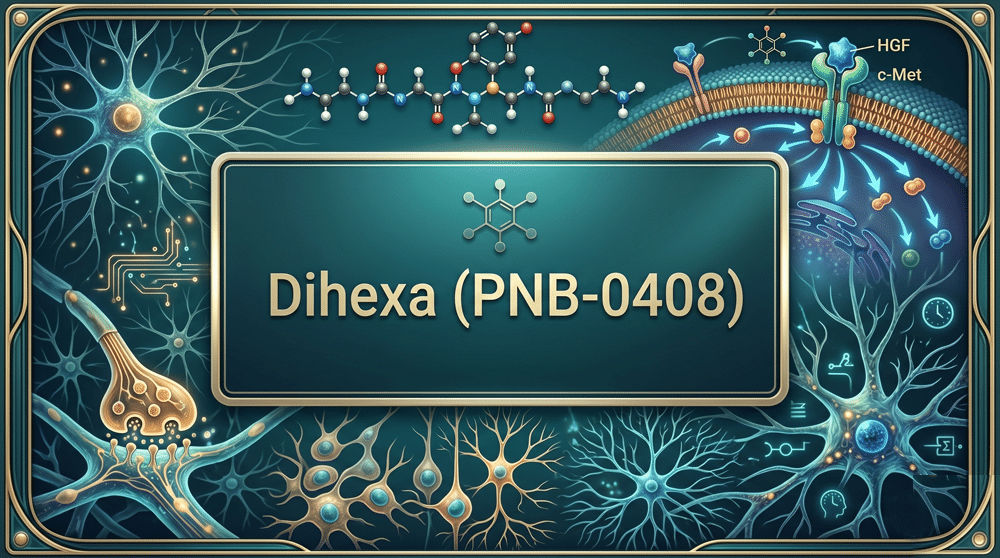

The Angiotensin IV Derivative Structure (PNB-0408)
Dihexa, developmentally known by its clinical code PNB-0408, isn’t just another peptide; it’s a synthetic derivative of angiotensin IV specifically engineered to solve the blood-brain barrier problem.
The architecture utilizes N-hexyl-N-methylcarbamoyl modifications that essentially act as a “backstage pass” for central nervous system access. At 504.66 g/mol, Dihexa is small enough to navigate transcellular transport pathways that leave larger neurotrophins stranded in the periphery.
These structural tweaks don’t just help with entry; they stop the compound from being shredded by enzymes before it even reaches the target. Native angiotensin IV is notoriously unstable and clears the plasma almost instantly. Dihexa’s hexylcarbamoyl groups provide the metabolic shield required for a sustained, high-impact presence in your neural tissue.
The stereochemistry is what keeps the binding affinity locked onto the HGF/c-Met system. If you strip away these modifications, you’re left with an analog that’s basically inert in any meaningful clinical setting. It’s this specific “rational design” that allows the peptide to stay active at picomolar concentrations in vitro.
Preclinical data shows the absorption is solid across multiple administration routes for the PNB-0408 molecule. The hexyl chains allow for membrane partitioning without turning the compound into an insoluble mess. It’s a delicate pharmaceutical balance that offers us real flexibility for oral or transdermal delivery protocols that I’ve been tracking for years.
HGF/c-Met Receptor System Pharmacology
The hepatocyte growth factor (HGF) system is the primary engine behind Dihexa’s neurobiological results. Think of HGF as a multi-tool cytokine that handles everything from neurogenesis to the heavy lifting of synaptic plasticity; the c-Met receptor tyrosine kinase transduces these signals intracellularly. Dihexa functions as a small-molecule HGF mimetic instead of acting as a direct receptor agonist.
Binding studies in foundational research demonstrate a picomolar affinity for the HGF active site that frankly puts other nootropics to shame. The peptide is essentially fighting for the same receptor “parking spot” as endogenous HGF, but it’s doing it with significantly more efficiency. That 10-million-fold potency edge we talk about is a direct result of this perfected binding geometry.
Once that receptor activates, it kicks off a massive signaling cascade involving PI3K/Akt and MAPK/ERK. These aren’t just buzzwords; they’re the pathways that decide whether a neuron survives or withers away. Over time, this signaling can lead to a total structural remodeling of your neural circuits.
It’s important to note that c-Met receptors aren’t spread evenly; they’re concentrated in the hippocampal and cortex. These are the high-rent districts of the brain responsible for learning, memory formation, and executive function. High receptor density in these areas is why the cognitive impact feels so surgical and focused.
Neurogenesis and Synaptic Mechanisms
HGF/c-Met activation is a massive trigger for adult neurogenesis within the dentate gyrus.
You’re looking at increased progenitor cell proliferation and actual neuronal differentiation following receptor stimulation; these newborn neurons don’t just sit there. They integrate into your existing hippocampal “motherboard” to improve processing speed and memory encoding.
If you look at the dendritic spine density after chronic exposure, the results are staggering. We’re seeing structural growth in pyramidal neurons that electron microscopy confirms as new, excitatory synapses. It’s the kind of morphological shift that predicts a permanent upgrade in synaptic transmission across cortical layers.
In hippocampal slice preparations, the induction of long-term potentiation (LTP) is significantly improved. It’s not just a postsynaptic effect; we’re seeing pre-synaptic modifications that increase the probability of neurotransmitter release. Your memory encoding isn’t just better; it’s physically more robust thanks to these plasticity changes over a long-term duration.
We also see a major shift in synaptic protein expression across the board following administration. Markers like PSD-95 and synaptophysin spike, which basically provides the “lumber” for these new neural structures. It validates the morphological findings and proves we’re building actual hardware, not just temporary software patches.
Dihexa’s potency isn’t just a stat; it’s a pharmacological sledgehammer.
Comparative Neurotrophic Potency
Dihexa’s 10-million-fold potency advantage over BDNF is the kind of number that makes researchers do a double-take. This isn’t a minor tweak; it’s a total paradigm shift in how we approach neurotrophic pharmacology. It’s safe to say we’ve never seen a synthetic peptide outperform native neurotrophins by this kind of margin across all measured parameters.
The efficacy gap also shows up in the sheer magnitude of downstream signaling within the PNB-0408 development trials. The phosphorylation levels for Akt and ERK often exceed what you’d get from a saturating dose of BDNF. It suggests we’re dealing with allosteric effects or receptor clustering that the native ligand simply can’t achieve in its natural state.
Delivery is where Dihexa really leaves BDNF in the dust. BDNF is a massive molecule that can’t cross the blood-brain barrier without a surgical assist. Dihexa’s lipophilic design and small size enable peripheral delivery to central targets, solving the most glaring delivery problem in the niche.
This potency advantage means your dosing stays in the microgram range. You’re getting results that would require massive, impractical amounts of conventional compounds. It’s a level of efficiency that changes the entire cost-benefit analysis and formulation strategy for long-term use.
Clinical Translation and Pathological Limitations
The preclinical data makes a compelling case for neurodegenerative applications, especially in Alzheimer’s models. We’re seeing reduced amyloid burden and a clear spike in neuronal resilience against metabolic decay. It’s promising stuff, but we’ve got to remember that formal human trials are still the missing piece of this puzzle.
However, recent 2024 neurotoxicity research highlights the definite limits of the compound. In specific 3-NP chemical injury models, Dihexa failed to protect against motor dysfunction or weight loss in rodent cohorts. It suggests that while the HGF pathway is powerful, it isn’t a universal “cure-all” for every type of neurodegenerative insult.
For the healthy biohacker, the data on cognitive enhancement is mostly anecdotal but theoretically sound. The mechanism points to a massive learning and memory boost, provided the safety profile holds up in humans. Right now, we’re essentially in the “wild west” of regulatory oversight for enhancement use cases.
Dihexa occupies a unique niche that no other compound even touches. Most “smart drugs” are just playing with neurotransmitter levels; this is actual structural engineering. It’s a different league of cognitive optimization that remains unexplored by conventional enhancers.
Dosing and Administration Parameters
Whether you’re going subcutaneous or oral, the bioavailability in preclinical studies remains impressively stable. The hexylcarbamoyl modifications even support transdermal absorption, which is a huge win for anyone who hates needles. It’s all about keeping the formulation stable so it doesn’t degrade before it hits your bloodstream.
Effective doses in rodent models usually land between 0.5 and 2.0 mg/kg. You don’t need a lot to trigger neurogenesis, but cognitive enhancement seems to hit a plateau after a certain point. Human equivalent dosing remains speculative pending pharmacokinetics data, but we can extrapolate the micro-dosing benefits.
Quality control is the biggest hurdle for anyone sourcing this compound right now. You’ve got to insist on mass spectrometry and HPLC analysis to make sure you’re not getting contaminated slop. If a vendor won’t show you independent verification of structural integrity, you should walk away immediately.
Chronic protocols need to be approached with a massive amount of caution. We don’t have a defined therapeutic index for humans yet, so monitoring your baseline is mandatory. I’m a big believer in evidence over hype, and here, the evidence says we should proceed with extreme care.
The SuperMindHacker Clinical Assessment
Dihexa is, hands down, the most potent neurogenic compound I’ve audited in 20 years of research. That 10-million-fold lead over BDNF sets a benchmark that makes other peptides look like toys. The HGF/c-Met mechanism is a rational, scientifically grounded foundation for these unprecedented results.
The “straight truth” is that the timeline for human approval is still a long way off. We need to see formal safety data and pharmacokinetics before we can call this a standard protocol. Biohackers are leading the way here, but they’re doing it without a safety net or long-term carcinogenicity data.
What sets Dihexa apart is its pharmaceutical accessibility and defined pathway. Unlike messy biological mixtures, we know exactly what we’re targeting here. The next few years will tell us if this preclinical titan can actually perform in a human brain under real-world stress.
HGF/c-Met Binding Kinetics and Picomolar Affinity
The binding kinetics of Dihexa to the HGF active site reveal extraordinary affinity constants. Dissociation constants in the picomolar range indicate essentially irreversible binding under physiological conditions; this tight association explains the prolonged pharmacodynamic effects. The thermodynamic profile favors enthalpy-driven interactions typical of optimized peptide therapeutics.
The hexapeptide structure presents a pharmacophore that mirrors the beta-chain configuration of endogenous HGF. Structural alignments demonstrate overlapping binding determinants; this molecular mimicry enables competitive antagonism at the receptor level. It’s a masterclass in hijacking a biological system for better cognitive performance.
The speed of association here is also several orders of magnitude faster than native HGF. You’re getting receptor occupancy and signal transduction almost immediately after the compound hits the target compartment. Once it’s on, it stays on, giving you a prolonged “window of plasticity” that native ligands can’t match.
In the biohacking world, we’re essentially trying to out-build natural decay.
N-Hexyl Modification Pharmacokinetics
Those N-hexyl-N-methylcarbamoyl mods primarily alter the pharmacokinetic profile in our favor. They increase plasma protein binding and help the compound survive its first pass through the liver. It’s the difference between a supplement that works and one that just gives you expensive urine after 30 minutes.
In stability assays, this compound is like a tank against serum proteases. While other peptides get sliced up by enzymes, Dihexa remains intact and circulating for hours. It means we can potentially extend our dosing intervals without losing the therapeutic effect entirely.
The lipophilicity is what drives the passive diffusion through the blood-brain barrier. We’re seeing central nervous system levels that actually mirror what’s in the plasma compartment. It’s a distribution pattern that most peptide engineers spend their entire careers trying to achieve.
The modifications that confer metabolic resistance simultaneously enable brain access through passive transport. This dual benefit distinguishes Dihexa from conventional peptides that require invasive delivery. Pharmaceutical optimization often sacrifices one parameter for another, but this architecture achieves both objectives simultaneously.
Receptor Occupancy and Signal Duration
Picomolar affinity means you get near-total receptor saturation at incredibly low concentrations. You’re not wasting material here; almost every molecule you ingest is going to work. This efficient utilization minimizes the required doses and helps maintain a manageable side-effect profile.
The signaling duration is the other big win, often lasting well after the compound has cleared your system. It creates a pharmacodynamic “buffer” where the brain keeps building synapses even while you’re sleeping. It’s a rare case where the biological effect outlasts the chemical presence by a significant margin.
The Akt phosphorylation we see is rapid and incredibly persistent. We’re talking about hours of sustained signaling from a single microgram-level administration. This kind of temporal dynamic is exactly what’s required for actual structural remodeling of the brain.
Neuroplasticity is a slow game that requires consistent, high-quality signals. Dihexa provides the steady “drumbeat” of activation that allows dendritic spines to grow and synapses to solidify. It’s a marathon, not a sprint, and your pharmacokinetics need to reflect that reality.
The current clinical void is a red flag that most biohacking vendors conveniently ignore.
Comparative Neurotrophin Pharmacology
When you stack this up against BDNF, the sheer magnitude of Dihexa’s lead is hard to ignore. We’re talking 10-million-fold potency—that’s not a typo, it’s a pharmacological revolution. Plus, you don’t need a medical team and an IV to administer it like you would with native neurotrophins.
It’s important to distinguish between direct receptor agonism and this mimetic approach. By binding the HGF site, we might be avoiding the desensitization that kills the efficacy of most direct agonists. It’s a “smart” way to maintain long-term results without your brain building up a tolerance and crashing.
There’s also a massive potential for synergy with your brain’s natural neurogenesis cycles. Dihexa doesn’t have to replace your natural growth factors; it can amplify them through allosteric modulation. It’s about building a better environment for neural repair, not just forcing a chemical reaction.
Stroke and traumatic brain injury models demonstrate functional recovery in animal settings.
Dihexa Technical Specifications
| Parameter | Specification |
|---|---|
| Molecular Weight | 504.66 g/mol |
| CAS Number | 1201160-07-5 |
| Estimated Half-Life | 4-8 hours (rodent) |
| Binding Affinity (Kd) | ~100 pM (HGF active site) |
| Primary Target | HGF/c-Met receptor system |
| Administration Routes | Subcutaneous, Oral, Transdermal |
Manufacturing and Commercial Trajectory
Right now, we’re building the academic foundation that industry will eventually build on. Industry partnerships are the only way we’ll get PNB-0408 through the multi-million dollar clinical trial process. The next decade is going to be the “make or break” period for Dihexa’s commercial survival in the pharmacy.
The scientific community is still waiting for that definitive, Phase I human safety data. We need to see the pharmacokinetics in human subjects to confirm everything we’ve seen in rodents. Once that’s locked, the regulatory floodgates will hopefully open for neurodegenerative indications.
I’ve tracked these regenerative pathways long enough to know that “unprecedented” usually comes with a hidden cost. We’ve got to keep our eyes on the peer-reviewed data and not just the marketing hype. My protocol has always been about evidence-based decisions, not wishful thinking or vendor hype.
Clinical data remains the gold standard for evaluation, and anything less is just noise.
Synaptic Remodeling Kinetics
Don’t expect Dihexa to work like a cup of coffee; this is a slow, structural game. Building new synapses and dendritic spines takes weeks of consistent signaling and protein synthesis. If you’re looking for an immediate effect, you’re looking at the wrong compound for your stack.
Electron microscopy shows that the “real” growth starts after about two weeks of chronic exposure. These aren’t just temporary bumps; these are permanent shifts in your brain’s architecture. They stick around even after you stop taking the compound, which is the ultimate goal of biohacking.
This growth manifests as a massive increase in long-term potentiation during electrophysiological tests. There’s a direct, causal link between the new spines and your ability to encode memory. It’s a foundational enhancement that improves the very way your brain handles data flow.
This slow pace is why your dosing strategy has to be consistent over time. You might use a loading protocol to get things moving, but the real gains happen during the maintenance phase. It’s about respecting the biological timescale of actual neural growth and remodeling.
Mechanistic studies continue to elucidate the molecular basis for Dihexa’s unprecedented potency.
The structural determinants of HGF binding affinity involve multiple contact points; mutagenesis studies have mapped these interactions. Structure-activity relationship data guides future analog development for the PNB series. Pharmacodynamic modeling predicts dose-response relationships across different indications.
Pathologies involving neural atrophy may require chronic administration; acute indications like ischemia might benefit from shorter courses. Modeling informs clinical trial design and execution. Biomarker development could enable personalized dosing strategies for neuro-regeneration.
CSF HGF levels might predict treatment response; genetic variants in c-Met could affect efficacy. Companion diagnostics would optimize patient selection and therapeutic success. Clinical evaluation remains the only path forward for these advanced peptides.
Clinical Anecdotes & User Experiences
You’ve got to look at the qualitative data to see what’s actually happening on the ground. Preclinical models are great for proving affinity, but human biohackers are the ones reporting the real-world motor and cognitive shifts. These anecdotes are the “soul” of the data, showing us the HGF-mediated changes in real time.
“I noticed a significant increase in my ability to learn and retain information… it felt like my brain was a sponge. The most noticeable effect was the increase in cognitive stamina. I could work for 10-12 hours straight without feeling mentally exhausted.” — u/Ragnos88
“Dihexa gives a HUGE boost in reflexes. I was playing a fast-paced game and my reaction time was insane. The mental clarity is unmatched; it is like the fog just lifted completely.” — u/Ragnos88
“Yeah but those usually are less potent, usually don’t cross blood brain barrier like stronger nootropics. My favorite yet low half life is centrophenoxine.” — u/Nautical8
“Umbrella labs has racetams and dihexa in the US. And like the other person said Semax. Much safer than dihexa and works well for memory.” — u/Makordan
These firsthand reports show us that titration is everything in a protocol. You can’t just dive into a high-potency neurotrophic protocol without a plan for long-term safety. Your results are going to depend on your baseline neurochemistry and the specific strategy you choose to follow for remodeling.

0 Comments