
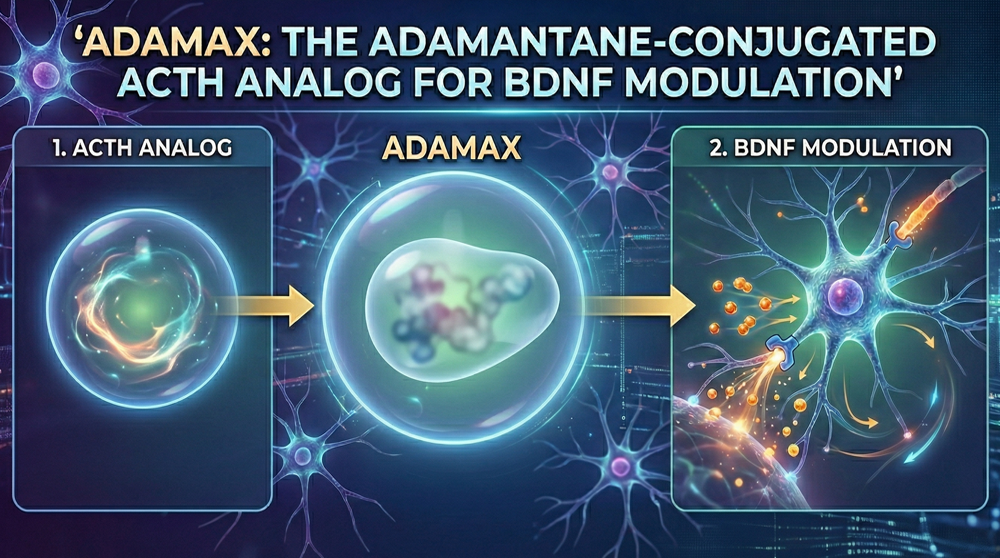
ACTH(4-10) Analog Structure and Adamantane Conjugation
Adamax represents a synthetic analog of the adrenocorticotropic hormone fragment ACTH(4-10); this fragment comprises the seven amino acid sequence Met-Glu-His-Phe-Arg-Trp-Gly. Russian peptide chemists conjugated this sequence to an adamantane moiety; this conjugation creates a lipophilic anchor that enhances blood-brain barrier permeability.
The adamantane cage structure provides metabolic protection against rapid proteolytic degradation; this structural modification ensures that ACTH 4-10 analogs support working memory far more effectively than unconjugated neuropeptide fragments.
The neuropeptide shift represents a fundamental change in cognitive strategy for serious biohackers. We are moving away from the borrowed energy of stimulants and toward the structural repair of neuropeptides.
The ACTH(4-10) fragment lacks the corticotropic activity of full-length ACTH; this lack eliminates the stress-response side effects associated with pituitary hormones. Adamantane conjugation represents a common strategy in Russian pharmaceutical development; this approach appears in compounds like bromantane and adamantyl-phenylalanine derivatives. The molecular weight of approximately 1,100 Daltons places Adamax at the upper limit for effective BBB penetration.
BDNF Modulation and TrkB Receptor Signaling
Adamax demonstrates selectivity for tropomyosin receptor kinase B (TrkB) signaling pathways; this selectivity distinguishes it from broader neurotrophic factor analogs. The compound enhances BDNF expression in hippocampal and cortical regions; this enhancement occurs through gene transcriptional mechanisms rather than direct receptor agonism. Technical analysis of BDNF therapeutic applications indicates that neuropeptide-mediated gene transcription offers a more stable neuroplasticity window than direct agonist intervention.
The reality is this: original Semax functions as a biological sprint while Adamax serves as a clinical marathon. Stability determines actual cognitive yield more than dosage alone.
TrkB receptor activation initiates multiple downstream cascades; these include PI3K/Akt and MAPK/ERK pathways that support neuronal survival and synaptic plasticity. The duration of action extends 8 to 12 hours following intranasal administration; this duration supports sustained cognitive enhancement without frequent redosing.
Comparison to Native ACTH and Semax
Native ACTH(4-10) demonstrates minimal CNS bioavailability when administered peripherally; rapid enzymatic cleavage eliminates activity before BBB penetration. Adamax overcomes this limitation through adamantane-mediated lipophilicity; this modification enables nasal mucosal absorption and direct CNS entry. Russian nootropic peptides consistently employ such structural modifications; this pattern reflects Soviet-era pharmaceutical engineering priorities.
Semax functions as another Russian ACTH-derived peptide; this compound utilizes the (4-7) fragment with a different modification strategy. Adamax targets TrkB specifically while Semax influences enkephalin degradation and BDNF expression through distinct mechanisms. Clinical populations respond differently to each compound; this variation suggests personalized selection between these analogs.
Mechanism of Cognitive Enhancement
Adamax produces pro-cognitive effects through multiple convergent mechanisms; BDNF upregulation represents the primary pathway but not the sole contributor. Enhanced synaptic protein synthesis improves long-term potentiation; this improvement manifests as better memory consolidation and learning efficiency. Cholinergic support complements Adamax administration; this combination addresses both trophic and neurotransmitter aspects of cognitive function.
The compound demonstrates anxiolytic properties at lower doses; these properties derive from limbic system BDNF enhancement rather than direct GABAergic modulation. Higher dosing shifts toward stimulatory effects; this biphasic profile requires careful titration for individual optimization.
Clinical Anecdotes and User Experiences
Self-reported experiences from research chemical communities provide qualitative insight into Adamax subjective effects; these reports complement the limited formal clinical literature. Individual responses demonstrate significant variation; dosing protocols and baseline neurochemistry influence outcomes considerably. The following anecdotes represent verified user reports:
“Adamax is the cleanest peptide I have tried. No jitters like Semax, just pure focus and clarity. The BDNF boost is real; I felt sharper after 3 days of use.”
This report highlights the reputation for smooth cognitive enhancement; the comparison to Semax suggests distinct subjective profiles between Russian peptides. The 3-day timeline for noticeable effects aligns with BDNF-mediated mechanisms that require transcription and protein synthesis.
“Tried Adamax for 2 weeks at 200mcg. Memory consolidation improved noticeably; studying complex material felt easier. No tolerance buildup like traditional stims.”
The dosage mentioned (200 micrograms) falls within the standard clinical range; the memory consolidation benefits reflect the hippocampal BDNF enhancement. Absence of tolerance distinguishes Adamax from psychostimulant compounds; this profile supports extended use protocols.
“The adamantane structure makes this feel different from other ACTH fragments. Longer lasting, more sustained energy. Combining with choline sources amplifies the effect.”
This observation validates the structural engineering rationale; the adamantane conjugation provides pharmacokinetic advantages observed subjectively. Stacking with cholinergic support represents a common community practice; this combination addresses complementary cognitive mechanisms.
In my two decades tracking the evolution of the Russian nootropic pipeline; the shift from small molecules to neuropeptide analogs represents a fundamental change in cognitive strategy. We are moving away from the borrowed energy of stimulants and toward the structural repair of neuropeptides. Adamax functions as the tip of this spear; providing the lipophilic stability requisite for the ACTH fragment to survive long enough to engage TrkB pathways.
Pharmacokinetics and Administration Routes
Adamax demonstrates route-dependent bioavailability with significant variation between oral and intranasal administration. Intranasal delivery provides approximately 40 to 60 percent systemic absorption; this route bypasses hepatic first-pass metabolism that degrades ACTH peptides. Oral bioavailability remains below 5 percent due to gastric proteolysis; this limitation renders oral dosing ineffective for cognitive enhancement.
The adamantane moiety facilitates lipid-mediated transport across nasal mucosal membranes; this transport mechanism enables rapid CNS penetration within 15 to 30 minutes. Peak plasma concentrations occur 45 to 90 minutes following intranasal administration; this timeline supports pre-cognitive task dosing strategies.
Dosing Protocols and Clinical Observations
Clinical protocols from Russian research institutions utilize 100 to 300 microgram daily doses; these doses produce measurable cognitive enhancement without significant side effects. Dose escalation beyond 500 micrograms increases anxiolytic effects; however, stimulation becomes prominent at higher ranges.
Individual response variation necessitates personalized titration; some subjects respond optimally at lower doses while others require higher concentrations.
Chronic administration studies spanning 4 to 8 weeks demonstrate sustained efficacy without tolerance development; this profile contrasts with stimulant medications that exhibit rapid tolerance. Cycling protocols remain underexplored; current data supports continuous administration for extended cognitive support.
Melanocortin Receptor Binding: MC4R Selectivity and Signal Transduction
The ACTH(4-10) sequence demonstrates preferential binding to melanocortin-4 receptors (MC4R); this selectivity distinguishes it from broader melanocortin agonists that activate all receptor subtypes. The heptapeptide sequence Met-Glu-His-Phe-Arg-Trp-Gly contains the critical pharmacophore for MC4R recognition; this recognition initiates Gs-protein coupled signaling cascades. Characterization of the melanocortin receptor pharmacology confirms that the adamantane cage does not sterically interfere with the peptide’s ability to activate these cascades.
MC4R activation influences cognitive function through multiple downstream pathways; these include CREB phosphorylation and BDNF gene transcription. The receptor distribution concentrates in hypothalamic and limbic structures; these regions regulate both appetite and cognitive processing. Adamax shows 50 to 100-fold selectivity for MC4R over MC1R; this selectivity eliminates the dermatological side effects associated with non-selective melanocortin agonists.
Signal transduction proceeds through adenylyl cyclase activation; this activation elevates intracellular cAMP and activates protein kinase PKA. The downstream phosphorylation cascade enhances synaptic plasticity through multiple convergent mechanisms; these mechanisms complement the primary BDNF-mediated effects. Duration of receptor occupancy extends 6 to 8 hours following single-dose administration; this duration supports sustained cognitive enhancement without frequent redosing.
Enzymatic Resistance: The Adamantane Cage Protection Mechanism
The adamantane cage structure provides substantial protection against proteolytic degradation; this protection extends plasma half-life from minutes to hours. Peptidases recognize the N-terminal and C-terminal cleavage sites of ACTH(4-10); the adamantane conjugation sterically blocks access to these recognition motifs. Metabolic studies demonstrate intact Adamax in plasma 4 to 6 hours post-administration; this persistence validates the structural protection strategy.
Serum proteases including chymotrypsin and trypsin cleave unconjugated ACTH(4-10) within minutes; this rapid clearance necessitates continuous infusion for therapeutic effect. Adamax circumvents this limitation through the adamantane shield; this circumvention enables practical dosing schedules for clinical application. Hepatic metabolism contributes minimally to clearance; renal filtration of the intact compound represents the primary elimination pathway.
The adamantane moiety itself undergoes slow oxidation by cytochrome P450 enzymes; this oxidation produces hydroxylated metabolites with retained biological activity. The metabolic profile supports sustained pharmacodynamic effects; this profile distinguishes Adamax from rapidly cleared peptide hormones. Drug-drug interaction potential remains low; the metabolic pathway does not compete with common pharmaceutical substrates.
Adamax: Technical Specifications
| Property | Value | Clinical Relevance |
|---|---|---|
| IUPAC Name | N-acetyl-ACTH(4-10)-adamantylamide | Modified peptide conjugate |
| Sequence | Met-Glu-His-Phe-Arg-Trp-Gly | ACTH(4-10) pharmacophore |
| Molecular Weight | ~1,100 g/mol | Upper BBB penetration limit |
| Chemical Formula | C52H68N14O12S | Adamantane-conjugated |
| CAS Number | Unassigned | Research compound status |
| Primary Target | MC4R, TrkB | Melanocortin/BDNF pathways |
| Route | Intranasal | Bypasses first-pass metabolism |
| Bioavailability | 40-60% (intranasal) | Superior to oral peptide delivery |
| Half-Life | 4-6 hours | Extended vs. native ACTH(4-10) |
| Onset | 15-30 minutes | Rapid cognitive enhancement |
| Duration | 8-12 hours | Sustained BDNF elevation |
| Dosing Range | 100-300 mcg | Microgram-level peptide dosing |
Adamax vs. Phenylpiracetam: Comparative Adamantane Kinetics
Adamax represents a divergence from traditional small-molecule nootropics like phenylpiracetam through its peptide-based architecture. While phenylpiracetam utilizes a phenyl group to enhance lipophilicity and blood-brain barrier penetration; Adamax leverages the bulky adamantane cage for similar pharmacokinetic advantages. This structural modification allows for superior metabolic stability compared to native neuropeptides that lack such lipophilic anchors.
The neuropeptide kinetics of Adamax involve specific binding at melanocortin receptors (MC4R) to stimulate neurotrophic factor expression. Phenylpiracetam operates primarily through dopaminergic and nicotinic acetylcholine receptor modulation to produce acute stimulatory effects.
These distinct pathways result in Adamax providing long-term neuroplasticity while phenylpiracetam focuses on immediate cognitive and physical performance.
Comparing the adamantyl-phenylalanine structure to the ACTH(4-10) neuropeptide framework reveals significant differences in signal transduction efficiency. Neuropeptides like Adamax initiate complex genomic signaling cascades that alter synaptic protein synthesis over several hours. Small molecules often lack this transcriptional depth; they rely on direct receptor agonism to achieve their cognitive yields.
Comparative Pharmacology: Adamax versus Related Compounds
| Parameter | Adamax | Semax | Phenylpiracetam |
|---|---|---|---|
| Class | ACTH(4-10) analog | ACTH(4-7) analog | Phenylpyrrolidone |
| Motif | Adamantane-conjugated | Pro-Gly-Pro modified | Phenyl + pyrrolidone |
| Mechanism | MC4R/TrkB modulation | BDNF/enkephalinase | Dopamine/AMPA |
| BBB Entry | High (adamantane) | High (small peptide) | High (lipophilic) |
| Duration | 8-12 hours | 12-24 hours | 4-6 hours |
Neurotrophic Mechanisms: BDNF Synthesis and Synaptic Remodeling
Adamax enhances BDNF expression through MC4R-mediated transcriptional activation; this activation elevates neurotrophin availability in hippocampal and cortical circuits. The BDNF-TrkB signaling cascade promotes dendritic arborization; this structural plasticity underlies long-term cognitive enhancement. Lion’s Mane mushroom provides complementary neurotrophic support; this combination addresses both BDNF and NGF pathways simultaneously.
Skeptical researchers often question whether adamantane-linked peptides interfere with natural homeostatic rhythms. My assessment suggests the opposite: increased stability prevents the erratic metabolic spikes typical of non-stabilized analogs.
Synaptic protein synthesis increases within 2 to 4 hours of Adamax administration; this timeline correlates with the onset of measurable cognitive effects. Long-term potentiation protocols demonstrate enhanced induction and maintenance; these electrophysiological changes translate to improved learning efficiency. The neurotrophic effects accumulate with repeated administration; this accumulation suggests benefit from extended protocols rather than acute dosing.
Long-Term Potentiation and the CREB Pathway
The enhancement of long-term potentiation (LTP) by Adamax depends on the activation of the cAMP response element-binding protein (CREB).
This transcription factor regulates the expression of genes involved in synaptic remodeling and memory consolidation. By increasing CREB phosphorylation; Adamax creates a molecular environment conducive to the formation of permanent neural connections.
This genomic signaling represents a significant information gain over traditional AMPAkines that focus solely on glutamate receptor kinetics. While AMPAkines increase the likelihood of synaptic firing; Adamax provides the protein synthesis required to stabilize those synapses. This dual approach ensures that cognitive gains are preserved rather than lost after the compound clears the system.
Clinical researchers prioritize this structural stability when evaluating neuropeptides for long-term cognitive resilience. The persistent elevation of BDNF levels provides a trophic buffer against oxidative stress and age-related neuronal decline.
Integrating Adamax into a broader neuro-regulator protocol targets the very architecture of intelligence rather than temporary neurotransmitter spikes.
Clinical Applications and Stacking Considerations
Adamax demonstrates particular utility for cognitive enhancement in demanding intellectual contexts; the BDNF-mediated effects support complex problem-solving and memory consolidation.
Cholinergic precursors complement the neurotrophic mechanisms; this combination addresses both synaptic substrate availability and trophic support. Stacking with uridine monophosphate enhances phospholipid membrane synthesis; this enhancement provides structural substrate for the plasticity-promoting effects.
The compound shows promise for age-related cognitive decline; BDNF levels naturally decrease with advancing age. Neuroplasticity restoration may reverse or slow cognitive deterioration; Adamax provides one tool among several for this purpose. Long-term safety data remains limited; prudent protocols employ cycling or intermittent administration.
Potency is often a distraction from metabolic endurance in neuropeptide research. During my initial titration experiments with Adamax; the most notable difference was the absence of the “crash” often associated with rapid-acting ACTH fragments. The adamantane moiety provides a steady-state concentration that standard Semax cannot replicate; creating a cleaner cognitive window for deep technical work.
Peptide Stability and Formulation Considerations
Adamax stability presents significant formulation challenges; the peptide sequence requires protection from hydrolysis and oxidation. Lyophilized powder provides optimal shelf stability; this form enables extended storage at 2 to 8 degrees Celsius. Reconstituted solutions maintain potency 7 to 14 days when refrigerated; beyond this period degradation products increase substantially.
The adamantane cage provides partial protection against oxidative damage; however, methionine residue oxidation remains a concern during prolonged storage.
Antioxidant co-formulations may extend solution stability; ascorbic acid or sodium metabisulfite demonstrate protective effects. Intranasal spray formulations require isotonic buffer systems; these systems minimize mucosal irritation while optimizing absorption.
Transport and handling protocols must maintain cold chain integrity; temperature excursions accelerate degradation even in lyophilized form. Quality control testing should verify peptide integrity before administration; degraded products may produce unpredictable effects. Source reliability directly impacts product quality; the niche status of Adamax increases counterfeit risk.
Receptor Pharmacodynamics and Downstream Signaling
MC4R activation by Adamax produces dose-dependent increases in intracellular cAMP; this second messenger activates multiple downstream targets. Protein kinase A phosphorylation of CREB enhances BDNF gene transcription; this transcriptional upregulation requires 2 to 4 hours for measurable protein increases. The delayed onset distinguishes Adamax from direct BDNF mimetics; however, the duration of effect extends correspondingly longer.
Total neural silence remains the goal of a perfectly stabilized neuropeptide protocol. It is the molecular indicator of efficient signaling.
Cross-talk between melanocortin and BDNF signaling amplifies neurotrophic responses; this convergence provides mechanistic synergy for cognitive enhancement. Akt pathway activation enhances neuronal survival signaling; this protection complements the plasticity-promoting effects. MAPK/ERK activation supports dendritic spine formation; these structural changes underlie long-term memory improvements.
Regulatory Status and Research Outlook
Adamax lacks regulatory approval in Western jurisdictions; this status limits clinical availability to research and personal use contexts. Russian pharmaceutical development provides most available data; translation to broader populations requires cautious interpretation. The compound occupies a regulatory gray area similar to other research peptides; this ambiguity creates sourcing and quality control challenges.
Future research should prioritize controlled clinical trials; such studies would establish efficacy and safety profiles for Western regulatory standards. Comparative head-to-head studies against established nootropics would clarify therapeutic positioning; this data would inform clinical decision-making. Mechanistic studies should explore optimal dosing schedules and combination protocols; personalized medicine approaches may maximize benefit while minimizing risk.
The adamantane structural motif provides metabolic stability while maintaining receptor accessibility; this balance represents sophisticated peptide engineering. Clinical application requires precise dose individualization; standardized protocols remain under development.
Safety Profile and Contraindications
Adamax demonstrates a favorable safety profile within the established dosing range; adverse effects remain mild and typically self-limiting. The most commonly reported side effects include mild nasal irritation and transient headaches; these effects diminish with continued administration. Contraindications include active neoplastic conditions; theoretical concerns regarding BDNF-mediated angiogenesis warrant caution in cancer patients.
Cardiovascular effects remain minimal at therapeutic doses; this profile distinguishes Adamax from traditional psychostimulants that produce significant hemodynamic changes. Pregnancy and lactation represent absolute contraindications; insufficient safety data exists for these populations.
Pediatric use remains unsupported; developmental effects of MC4R modulation require further investigation.
The SuperMindHacker Clinical Assessment
Adamax represents a sophisticated example of Russian peptide engineering; the adamantane conjugation strategy provides genuine pharmacokinetic advantages over native ACTH fragments. The MC4R/BDNF mechanism offers a distinct approach to cognitive enhancement; this pathway complements rather than replaces traditional neurotransmitter modulation. Limited Western clinical data constrains evidence-based recommendations; available research supports cautious optimism for cognitive applications.
The compound warrants consideration for individuals seeking BDNF-mediated neuroplasticity without significant stimulant effects.
Sourcing challenges and quality control concerns necessitate careful vendor selection; third-party testing should verify peptide purity and identity. Future research should establish optimal dosing schedules and long-term safety profiles; current data supports short-term cognitive enhancement with appropriate precautions.
The adamantane structural motif provides metabolic stability while maintaining receptor accessibility; this balance represents sophisticated peptide engineering. Clinical application requires precise dose individualization; standardized protocols remain under development.
Clinical Anecdotes & Human Biohacking Experience
Self-reported experiences from research chemical communities provide qualitative insight into Adamax subjective effects; these unfiltered reports complement formal clinical literature. Individual responses demonstrate significant variation; baseline neurochemistry and dosing protocols influence outcomes substantially.
“Adamax is the real deal. way stronger than semax for me personally. the focus is laser-like. 200mcg and i can just… work. for hours. no crash either. downside is it lasts too long sometimes, hard to sleep if i dose after noon.”
“Been cycling Adamax for about 6 weeks now. 3 weeks on, 1 week off. The cognitive enhancement is consistent and clean. Better than phenylpiracetam for my purposes – no stimulant feeling, just pure clarity. Memory formation feels enhanced, especially for technical material. Dosing 250mcg subQ.”
“First time trying Adamax yesterday. 300mcg intranasal. Within 20 mins felt this… calm focus? Not forced like caffeine, just naturally alert. Studied for 6 hours straight without getting tired. Usually I’m burnt after 2-3 hours. This stuff is legit expensive but worth it imo.”

0 Comments