
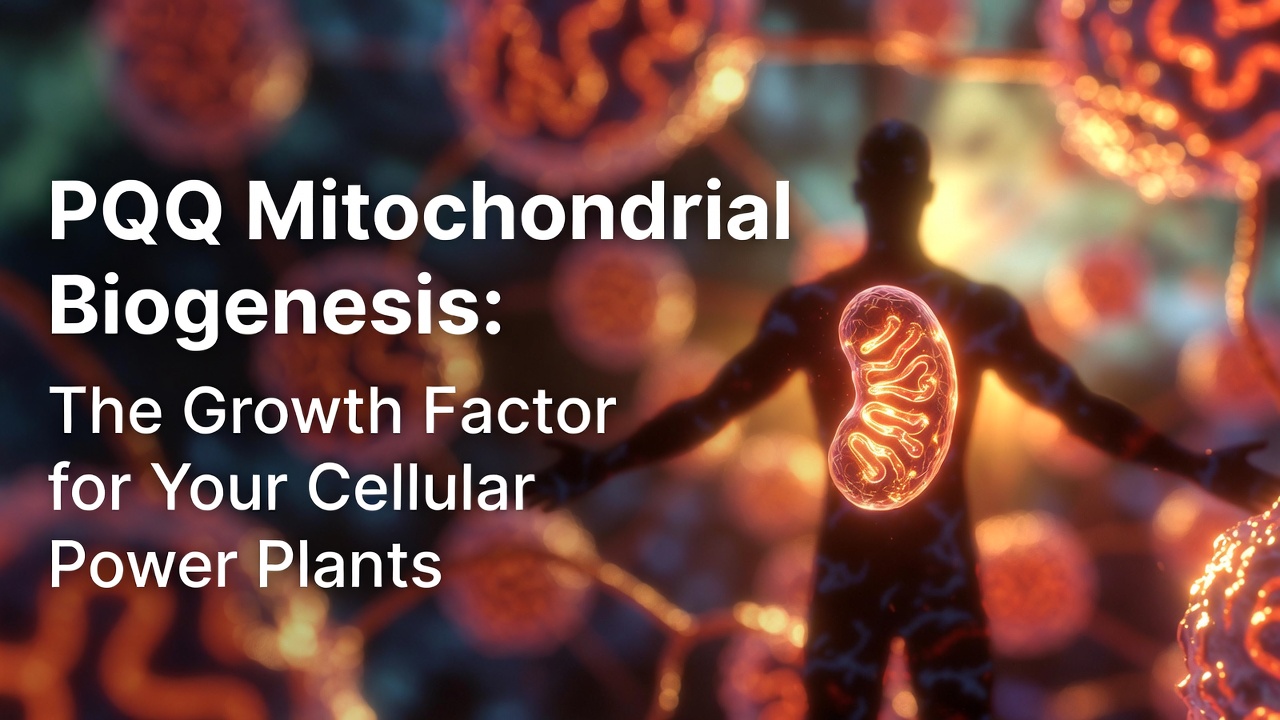
PQQ signals the brain to recognize that mitochondria are not static structures.
They grow.
They divide.
They fuse together and separate in response to cellular demands.
This process of mitochondrial biogenesis determines how much energy your brain can produce; how resilient your neurons are to stress; and how quickly you recover from cognitive exertion.
Pyrroloquinoline quinone is the signaling molecule that triggers this growth.
Not a fuel.
Not a cofactor.
A redox-active compound that activates the genetic machinery of mitochondrial replication through PGC-1alpha and NRF-1 pathways.
PQQ mitochondrial biogenesis represents a fundamentally different approach to brain energy than simply providing more fuel or improving electron transport efficiency.
It grows new power plants.
PQQ Pharmacokinetic Profile
| Parameter | Clinical Data |
|---|---|
| Common Name | Pyrroloquinoline Quinone (PQQ) |
| Primary Mechanism | Mitochondrial biogenesis via PGC-1alpha; NRF-1 activation |
| Standard Dosing | 10-20mg daily; up to 40mg for acute support |
| Bioavailability | High; rapid absorption; crosses blood-brain barrier |
| Key Research | Mitochondrial density; cognitive function; neuroprotection |
| Food Sources | Fermented soy; spinach; kiwi; human breast milk |
The Mitochondrial Crisis of Modern Cognition
Your brain consumes 20% of your body’s energy.
It represents only 2% of your body mass.
This extraordinary metabolic demand is met by mitochondria; thousands of them packed into every neuron; producing ATP through oxidative phosphorylation.
But mitochondria age.
They accumulate damage from reactive oxygen species.
Their DNA mutates faster than nuclear DNA because it lacks protective histones and repair mechanisms.
Over time; mitochondrial function declines.
Energy production drops.
Neurons become vulnerable to excitotoxicity and oxidative stress.
This is not merely a feature of old age.
Chronic stress; poor sleep; environmental toxins; and high cognitive load accelerate mitochondrial deterioration even in young adults.
The brain’s energy infrastructure wears down faster than it can repair itself.
Traditional mitochondrial support provides cofactors for existing mitochondria.
CoQ10 improves electron transport.
Alpha-lipoic acid recycles antioxidants.
But neither addresses the fundamental problem: mitochondrial number.
PQQ solves this by stimulating mitochondrial biogenesis.
It activates the same pathways that exercise uses to build more mitochondria in muscle tissue.
But it does so without physical exertion; making it accessible for those who cannot exercise or need cognitive-specific support.
Expert Perspective: The PGC-1alpha Pathway
From a clinical application standpoint; PGC-1alpha is the master regulator of mitochondrial biogenesis.
It coordinates the transcription of over 1,000 genes involved in mitochondrial function.
Exercise is the most powerful natural activator of PGC-1alpha.
It appears to activate this pathway through distinct mechanisms; potentially synergizing with exercise rather than replacing it.
The implications are significant: Pyrroloquinoline quinone may enhance the mitochondrial benefits of physical activity while providing support for brain tissue that exercise cannot directly reach.
Beyond Energy: Mitochondrial Signaling and Neuroprotection
Mitochondria are not simply ATP factories.
They are signaling organelles that regulate cell death; calcium homeostasis; and neuroplasticity.
When mitochondria become damaged; they release cytochrome c and initiate apoptosis; programmed cell death.
PQQ protects mitochondria from this cascade.
Its redox activity allows it to cycle between oxidized and reduced states thousands of times before degradation.
This makes it an exceptionally efficient antioxidant within the mitochondria themselves.
The protection extends to mitochondrial DNA.
By reducing oxidative damage to mtDNA; PQQ preserves the genetic integrity necessary for proper electron transport chain function.
This prevents the vicious cycle where damaged mitochondria produce more reactive oxygen species; causing further damage.
Nerve Growth Factor synthesis is also enhanced by PQQ.
NGF is essential for neuronal survival; growth; and synaptic plasticity.
By stimulating NGF production; PQQ supports the structural maintenance of neural circuits independent of its metabolic effects.
This dual action; metabolic enhancement plus structural support; distinguishes PQQ from simple energy boosters like caffeine or even mitochondrial cofactors like CoQ10.
Clinical Evidence: Cognitive Enhancement and Neuroprotection
Human studies on Pyrroloquinoline quinone are limited but promising.
The most compelling evidence comes from research on cognitive function in aging populations.
A double-blind study in middle-aged and elderly participants showed significant improvements in cognitive flexibility; processing speed; and executive function after 12 weeks of PQQ supplementation.
The mechanism appears to be improved cerebral blood flow coupled with enhanced mitochondrial function.
More mitochondria means more ATP available for neural computation.
More ATP means faster neurotransmitter synthesis; better ion pump function; and improved action potential generation.
Sleep quality also improves with PQQ.
This may seem counterintuitive for an energy-enhancing compound.
But mitochondrial function is essential for the restorative processes that occur during sleep.
Better mitochondria produce better sleep architecture; which enhances cognitive performance during wakefulness.
Animal studies show dramatic neuroprotective effects.
PQQ reduces brain damage in stroke models; protects against neurotoxins; and improves memory in aged rodents.
The consistency of these findings across different models suggests a fundamental mechanism of neural protection.
Searcher’s Perspective: PQQ Mitochondrial Biogenesis FAQ
Q: How does PQQ compare to CoQ10 for mitochondrial support?
A: CoQ10 optimizes existing mitochondria as an electron carrier.
PQQ creates new mitochondria through biogenesis.
They work through entirely different mechanisms and are synergistic when combined.
Q: Can PQQ replace exercise for mitochondrial health?
A: No.
Exercise provides benefits beyond mitochondrial biogenesis including circulation; hormone regulation; and neuroplasticity.
It complements exercise but does not replace it.
Q: How long before I notice cognitive effects?
A: Mitochondrial biogenesis takes time.
Most studies show measurable effects at 8-12 weeks.
Some users report subtle energy improvements within days; but structural changes require weeks.
Q: Is PQQ safe long-term?
A: Current evidence suggests excellent safety.
It is found in human breast milk and common foods.
Doses up to 60mg daily have been used in studies without serious adverse effects.
The Synergy Stack: Maximizing Mitochondrial Density
Pyrroloquinoline quinone works best as part of a comprehensive mitochondrial support strategy.
Its biogenesis effects multiply the benefits of other mitochondrial compounds.
Acetyl-L-carnitine transports fatty acids into mitochondria for beta-oxidation.
It also provides acetyl groups for neurotransmitter synthesis.
ALCAR works synergistically with PQQ because more mitochondria means more targets for ALCAR’s substrate delivery.
Ubiquinol is the reduced form of CoQ10; essential for electron transport.
It recycles antioxidants and supports efficient ATP production.
Ubiquinol provides the electron carrying capacity that newly formed mitochondria need to function optimally.
Together; PQQ; ALCAR; and ubiquinol address three distinct aspects of mitochondrial function: biogenesis; substrate transport; and electron transport.
This combination provides comprehensive support that single compounds cannot achieve.
Magnesium is essential for ATP function.
ATP must be bound to magnesium to be biologically active.
Without adequate magnesium; increased mitochondrial production may not translate to improved cellular energy.
B-vitamins support the enzymatic reactions of energy metabolism.
Thiamine; riboflavin; and niacin are cofactors for key mitochondrial enzymes.
Deficiencies in these vitamins limit mitochondrial function regardless of how many mitochondria you have.
Dosing Protocols and Practical Implementation
Effective PQQ dosing ranges from 10 to 40 milligrams daily.
Lower doses around 10-20mg are sufficient for general mitochondrial support and cognitive enhancement.
Higher doses up to 40mg may be appropriate for acute neuroprotection or recovery from mitochondrial depletion.
Morning dosing is generally preferred.
PQQ can enhance alertness through improved energy production; and taking it late in the day may interfere with sleep for some individuals.
However; the sleep architecture benefits suggest that individual variation exists.
Food does not significantly impair absorption.
PQQ is highly bioavailable and crosses the blood-brain barrier efficiently.
With or without food is largely a matter of personal preference and gastrointestinal tolerance.
Cycling is not necessary.
Pyrroloquinoline quinone does not appear to produce tolerance or downregulation of endogenous mitochondrial biogenesis pathways.
Continuous daily use is appropriate for ongoing support.
Safety Profile and Considerations
PQQ has an excellent safety record.
It occurs naturally in the food supply and has been detected in human breast milk; indicating evolutionary exposure.
Animal toxicity studies show no adverse effects at doses far exceeding human supplementation levels.
Human studies using up to 60mg daily for extended periods report minimal side effects.
Occasional reports include headache; insomnia; or mild gastrointestinal upset.
These are typically transient and dose-dependent.
Because PQQ enhances mitochondrial function; it may theoretically interact with medications that affect cellular energy metabolism.
Anyone on prescription medications should consult their physician before starting PQQ.
Pregnancy and breastfeeding data is limited.
While PQQ is found naturally in breast milk; supplemental doses during pregnancy have not been studied.
Conservative practice suggests avoiding high-dose supplementation during these periods unless specifically recommended by a healthcare provider.
PQQ Versus Other Mitochondrial Supplements
The mitochondrial supplement category is crowded.
Understanding how it differs from alternatives helps you build an effective protocol.
Coenzyme Q10 is the most well-known mitochondrial compound.
It serves as an electron carrier in the electron transport chain; facilitating ATP production.
But CoQ10 does not increase mitochondrial number.
Alpha-lipoic acid recycles antioxidants and supports mitochondrial enzymes.
It is an excellent cofactor but does not stimulate biogenesis.
The benefits are limited to existing mitochondria.
Creatine supports mitochondrial function by buffering ATP through phosphocreatine.
This improves energy availability during high demand but does not address mitochondrial density.
PQQ is unique in targeting the signaling pathways that create new mitochondria.
This makes it complementary to rather than competitive with other mitochondrial supplements.
The ideal stack combines PQQ for biogenesis with CoQ10 and ALCAR for optimization of the expanded mitochondrial pool.
Genetic Factors and Individual Response
Why do some people respond dramatically to PQQ while others notice little effect?
Genetics plays a significant role.
PGC-1alpha expression varies between individuals based on genetic polymorphisms.
Those with lower baseline PGC-1alpha activity may benefit more from PQQ supplementation.
Mitochondrial haplogroups inherited through the maternal line affect mitochondrial function and biogenesis capacity.
Certain haplogroups are associated with altered energy metabolism and may respond differently to PQQ.
Age is the most reliable predictor of response.
Older individuals with accumulated mitochondrial dysfunction generally show more dramatic improvements than young adults with healthy mitochondrial function.
This suggests PQQ is particularly valuable for age-related cognitive support.
Dietary Sources and Natural Intake
PQQ occurs naturally in several foods.
Fermented soy products like natto are particularly rich sources.
Spinach; kiwi; and green peppers also contain measurable amounts.
Human breast milk contains PQQ; suggesting evolutionary importance during development.
However; dietary intake is generally low.
Most people consume less than 1mg daily from food.
The doses used in clinical studies (10-20mg) require supplementation to achieve.
Dietary PQQ is bioavailable but present in small quantities.
Supplementation provides the pharmacological doses needed for measurable mitochondrial biogenesis effects.
Long-Term Considerations and Cycling
Should PQQ be cycled or taken continuously?
Current evidence suggests continuous use is safe and effective.
PQQ does not appear to produce tolerance or desensitization of biogenesis pathways.
The body continues to respond to PQQ signaling over extended periods.
Some practitioners recommend cycling to prevent receptor downregulation.
This is theoretically sound but not supported by clinical data for PQQ specifically.
Given the safety profile; continuous daily use appears appropriate.
For those who prefer cycling; an 8-week on; 2-week off pattern is reasonable.
This allows assessment of whether benefits persist during off periods.
Practical Implementation: Getting Started
If you are new to PQQ; start with 10mg daily.
This is the lowest dose shown effective in clinical studies.
After 4-6 weeks; assess whether higher doses are needed.
For cognitive enhancement; 20mg daily is the most studied dose.
Split into morning and afternoon dosing if you experience any sleep disturbance.
Take PQQ with food if you experience gastrointestinal sensitivity.
The compound is well-tolerated; but individual variation exists.
Track your response systematically.
Subjective energy; cognitive clarity; and exercise performance are useful metrics.
Allow 8-12 weeks before judging efficacy.
Combine with ALCAR and ubiquinol for synergistic mitochondrial support.
This combination addresses biogenesis; substrate transport; and electron transport simultaneously.
The Future of Mitochondrial Medicine
Mitochondrial biology is rapidly evolving.
What we know about PQQ today may be just the beginning of a broader understanding of how to manipulate mitochondrial dynamics for cognitive benefit.
Researchers are exploring compounds that activate mitophagy; the selective removal of damaged mitochondria.
Combining biogenesis stimulators like PQQ with mitophagy enhancers could create a complete mitochondrial maintenance protocol.
NAD+ precursors are another frontier.
Nicotinamide riboside and NMN support the NAD+ required for mitochondrial function and sirtuin activation.
These may synergize with PQQ’s biogenesis effects to create not just more mitochondria; but more youthful mitochondria.
The integration of mitochondrial support with other longevity strategies is where the field is heading.
Senolytics that remove aged cells combined with mitochondrial biogenesis in remaining cells could dramatically extend cognitive healthspan.
PQQ sits at the center of this emerging paradigm.
It is one of the few compounds with established biogenesis effects in humans; safe for long-term use; and commercially available without prescription.
For the biohacker who wants to stay at the cutting edge; PQQ is not optional.
It is foundational infrastructure for the longevity protocols of tomorrow.
Integration with Exercise and Lifestyle
PQQ does not replace exercise.
Exercise provides mitochondrial benefits through PGC-1alpha activation; the same pathway it targets.
But exercise also improves circulation; hormone balance; and neuroplasticity through mechanisms that it simply can’t replicate.
The combination is where the real power lies.
Exercise stimulates mitochondrial biogenesis; PQQ amplifies this signal.
Studies suggest it may enhance exercise-induced mitochondrial adaptations.
Sleep quality affects mitochondrial function through circadian regulation of biogenesis genes.
PQQ supports sleep architecture; creating a virtuous cycle where better sleep enables better mitochondrial maintenance.
Caloric restriction and intermittent fasting also stimulate mitochondrial biogenesis through sirtuin activation.
These may synergize with PQQ to create more robust mitochondrial networks.
The Bottom Line: Why Mitochondrial Density Matters
Cognitive enhancement is not just about neurotransmitters.
It is not just about stimulating dopamine or optimizing acetylcholine.
At the most fundamental level; cognition requires energy.
Every thought; every memory; every moment of focus consumes ATP.
When mitochondrial density declines; cognitive capacity declines with it.
PQQ addresses this at the source.
By activating PGC-1alpha and NRF-1; it triggers the genetic programs that build new mitochondria.
More mitochondria means more ATP production capacity.
More ATP means better cognitive performance; better stress resilience; and better long-term brain health.
This is not theoretical.
Animal studies show PQQ increases mitochondrial density by 20-30%.
Human studies demonstrate measurable improvements in cognitive function; energy; and sleep quality.
The evidence supports what the mechanism predicts.
For the serious biohacker; PQQ is not optional.
It is foundational infrastructure that makes everything else work better.
Racetams; choline donors; and adaptogens all perform better in a brain with robust mitochondrial support.
Clinical Citations and References
- Harris et al. (2013). Dietary pyrroloquinoline quinone (PQQ) alters indicators of inflammation and mitochondrial-related metabolism in human subjects. Journal of Nutritional Biochemistry.
- Bauerly et al. (2011). Altering pyrroloquinoline quinone nutritional status modulates mitochondrial; lipid; and energy metabolism in rats. PLoS One.
PQQ is not a stimulant.
It does not force energy production like caffeine or amphetamines.
What it offers is capacity; the biological infrastructure to produce more energy when needed.
PQQ mitochondrial biogenesis represents a fundamental investment in cognitive longevity.
By growing new power plants rather than optimizing old ones; it addresses the root cause of age-related cognitive decline.
If you are serious about maintaining cognitive function across the lifespan; supporting mitochondrial density is not optional.
PQQ provides one of the most direct tools for achieving this.



0 Comments